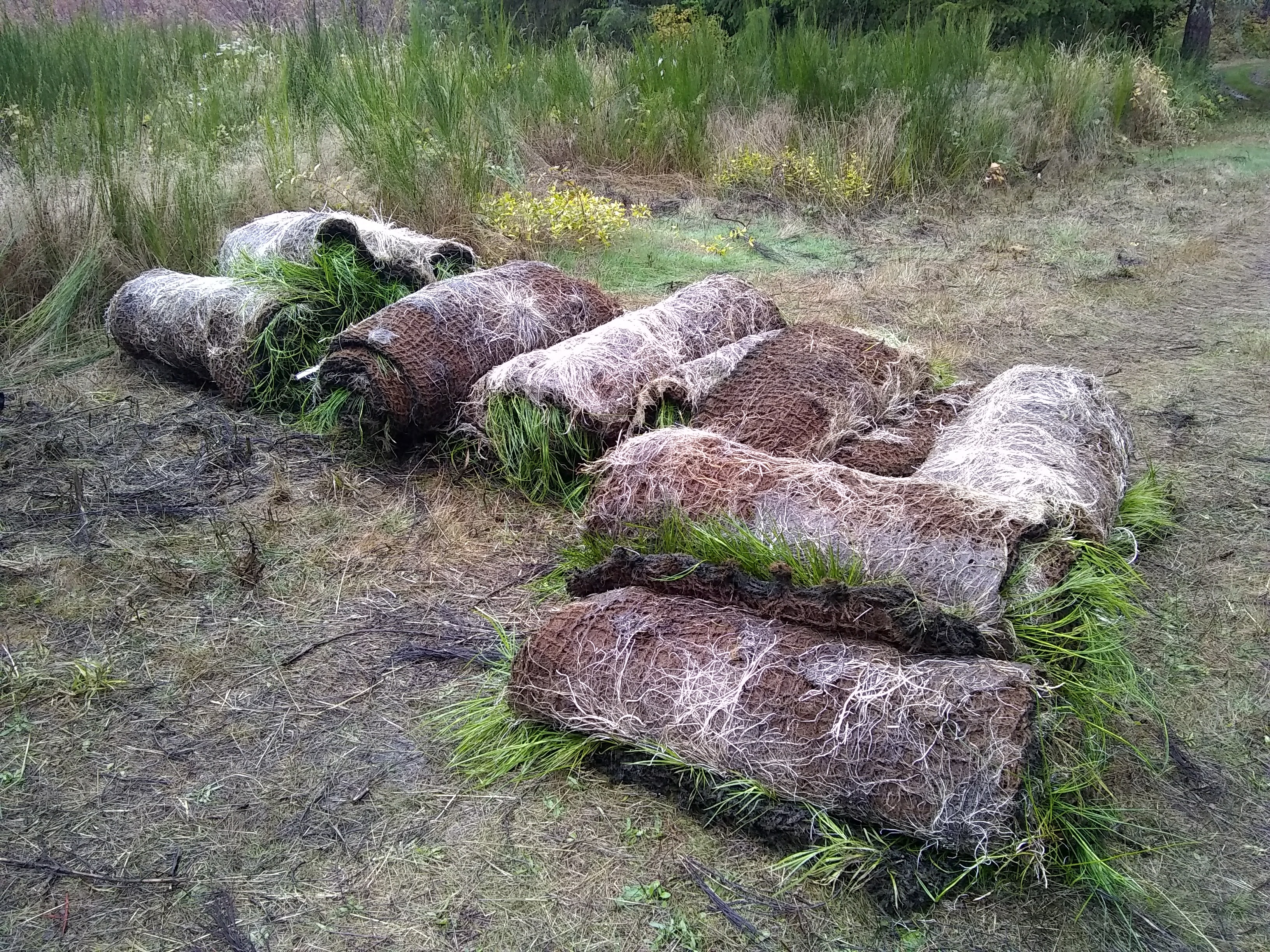
Prior to delivery, we rolled up the mats and let them drain for 24 hours. Even with reduced water, each mat weighs about 60 pounds when it is delivered—healthy roots and shoots are heavy!
Each mat contains a combination of native wetland plants: spreading rush (Juncus supiniformis), tall mannagrass (Glyceria elata), and creeping spike-rush (Eleocharis palustris). The mats were produced in Stafford Creek Corrections Center’s aquaponics greenhouse by a team of corrections staff, incarcerated technicians, and SPP-Evergreen staff.
Staff and volunteers from CNLM and JBLM lay three, 1-meter by 3-meter mats side by side and anchor them with biodegradable stakes.
At each site, the mats are arranged in squares, three meters on each side. Staff and volunteers from JBLM and CNLM prepared the sites using a variety of combinations of herbicide, mowing, and solarization to remove the reed canarygrass; on the day of mat installation, they removed dead grass and root material with weed cutters making it easier for the plants in the mats to make contact with soil and establish themselves quickly. Teams will revisit each square to determine which of the various reed canarygrass treatments best allowed the native wetland species to take hold.
At the site shown here, reed canarygrass was treated only by mowing; in the background, you can see its pre-mowing height of up to six feet tall. Sarah Hamman deploys a water depth gauge–believe it or not, this is a wetland!
Will the coconut coir mats prevent reed canarygrass from growing back? Will the native plants grow quickly enough to establish healthy populations, competing for space with the reed canarygrass? Stay tuned to find out!
Three, 3-meter square mats in each replicate (experimental copy), three replicates per site, and three sites!
By Bethany Shepler, SPP Green Track Program Coordinator and
Eugene Youngblood, Roots of Success Master Instructor
Because Youngblood is a Master Trainer for Roots of Success, he can certify new instructors. Youngblood certified Reyes (left) and Berube (center) for the program at Coyote Ridge Corrections Center in 2015 and 2017; Reyes and Berube have facilitated 7 classes of Roots students. Photo by DOC staff.
I recently had the pleasure of meeting one of our Master Trainers for Roots of Success in Washington State, Eugene Youngblood. He recently relocated from Coyote Ridge Corrections Center to Monroe Correctional Complex and spoke at a class graduation in the Sustainable Operations Lab (SPL). I was struck by his words because, not only were they relevant to the people assembled, but to so many other people inside and outside prisons. He said “to give praise is to assign value and the people here need to know that they are worthy of value.” Too often in our world, people tend to believe they don’t have value. Perhaps Youngblood is on to something: Maybe by assigning value to those we’ve locked away, we can began to change the world.
A Roots of Success class graduation at CRCC in 2016; Youngblood is at the far right. Photo by Ricky Osborne.
I want to convey more of Mr. Youngblood’s wisdom, and have a letter from him to share:
The great George Bernard Shaw said, “The reasonable man adapts himself to the world: the unreasonable one persists in trying to adapt the world to him. Therefore all progress depends on the unreasonable man.”
Sustainability in prison sounds like an oxymoron to most people, I am sure. Prisons going green and prisoners being at the forefront of this movement sounds unreasonable, if not outright unbelievable. Yet, here we are at the Monroe Correctional Complex – Washington State Reformatory Unit, attempting to adapt the world to us, understanding that all progress depends on us… “The unreasonable”.
At our SPL (Sustainability Practice Lab) we are supervised and supported by Correctional Officer Jeffrey Swan, who has done an amazing job creating an atmosphere that is both professional and positive. In these positions, we are gaining valuable job skills and invaluable knowledge that will help us in our quest for successful reentry. I would be remiss if I did not say how much support we get for programs such as this from administration here. CPM Williams continues to be the unseen helping hand, extending to us the support we need to continue the work we are able to do, even when we don’t know how far she has gone to make this all possible. We have a thriving vermiculture program, along with wheelchair and bicycle restoration programs. The wheelchairs are refurbished and restored then donated to those in need across the world. Our last three shipments went to Ghana, Guatemala, and Thailand. The bicycles are refurbished and restored then gifted to local Boys & Girls clubs, YMCA, and to the local police department for their bike drive giveaway. On top of all this work, we are learning at the same time. We have just completed the second Roots of Success environmental literacy class for Monroe Correctional Complex.
The Roots of Success program has become a real agent of change for us in prison. If you want to help people change their actions, the first thing you have to do is help them change their thoughts. How do you help someone change his or her thoughts? You provide them with more information and then you give them the tools to turn that information into knowledge. Real change takes place from the inside out – what is under the ground produces what is above the ground. Thus, we have “Roots” of success and not “Fruits” of success. Environmental literacy helps us understand the impact we have on the environment. Roots of Success helps take that to the next level with prisoners; we are learning about ourselves and the impact we have, not just on our immediate environment (Prison) but the impact we have on our friends, families, our own communities, and ultimately our extended environment (Society). We are helping to make prison sustainable, helping to contribute to the sustainability of society, and all the while helping ourselves become better people in the process by taking what we know and turning that into what we do. In the true spirit of the quote by George Bernard Shaw, we are being “unreasonable” and thus producing progress in THE world and in OUR world as well.
Youngblood (far right) stands with another graduating class from CRCC, in 2014. Photo by SPP Staff.
Text and photos by Bethany Shepler, SPP Green Track Coordinator
Class photo of beekeeping apprenticeship students with Ed Baldwin (far left) and Duane McBride (second from the left).
The bees may have turned in for winter, but beekeeping students at Stafford Creek Correction Center (SCCC) are still hard at work. Their first beekeeping apprenticeship course is almost done and we are impressed and thankful.
I had the pleasure of sitting in on the last class in the series at SCCC, taught by Duane McBride from the Olympia Beekeepers Association. The students came well prepped for class and full of thoughtful questions. Ed Baldwin, a Grounds Specialist at Stafford Creek, is taking the class as well. Ed hopes to continue to expand the beekeeping program—it has been in place since 2009, but is doing better than ever with the renewed attention and education.
Duane McBride answering questions about a test the students took in an earlier class.
Students that go through the beekeeping apprenticeship course graduate as certified beekeeping apprentices and can put those skills to further use upon release.
Since last spring’s Beekeeping Summit, we have seen beekeeping programs booming statewide – adding nine programs in only six months! We are thrilled by all of the support and enthusiasm surrounding the beekeeping programs. Beekeeping is really taking flight within Washington State prisons and we can’t bee-lieve how fast the program is growing. Keep up the hard work, Stafford Creek!
Students chuckle at a beekeeping pun during the class…we were buzzing with bee puns.
A student looks up something for reference as Duane McBride talks about hive care.
Students listen as Duane explains hive care techniques.
As class wraps up, students talk and laugh a little before returning back to their normal activities.
This is where the bees are housed at Stafford Creek. The inmates constructed the shelter, painted it, and made the beehives that now homes for two healthy hives.
Text and photos by Jessica Brown, SPP Turtle Program Coordinator
After several months of planning, a new wildlife Ecological Conservation program at Cedar Creek Correctional Facility will soon be up and running. We are excited to team up with biologists from the U.S. Forest Service to implement the woodpecker nest monitoring program. The program is mainly a research project: technicians review video footage of endangered woodpeckers at their nests, and document activities of animals that may depredate the nest.
Partners in endangered species Ecological Conservation for Cedar Creek Corrections Center, from left to right: Technician, John Fitzpatrick, Superintendent Douglas Cole, Loretta Adams (SPP Liaison), Philip Fischer (U.S. Forest Service), Kelli Bush (SPP Co-Director), Teresa Lorenz (U.S. Forest Service), Technician William Anglemyer
In part to allow the new program, Cedar Creek’s Ecological Conservation efforts will be served by a larger group of incarcerated technicians, adding about 6 more individuals to the existing two turtle technicians; the larger group will rotate through turtle and woodpecker programs, plus a future aquaponics program. Woodpecker technicians in the prison will receive similar training and education to that of undergraduate students who perform the same work. They will learn about topics such as wildlife species identification, ecology, Ecological Conservation, and data documentation.
New turtle technician, Mr. Fitzpatrick leads a tour of the turtle facility at Cedar Creek.
Last month, U.S. Forest Service biologists, Teresa Lorenz and Philip Fischer were able to visit the Cedar Creek facility and turtle technicians treated them to a tour of the western pond turtle program. The newest turtle technician Mr. John Fitzpatrick did a great job of leading his first tour for an outside group. Mr. Fitzpatrick, the first incarcerated winner of a Mike Rowe Foundation scholarship, has been an excellent addition to the turtle team; he brings an infectious, positive attitude, and zest for learning. We are thankful for the animal handling skills, training, and wealth of knowledge he is receiving from veteran turtle technician Mr. William Angleymyer.
Mr. Fitzpatrick explains the mealworm rearing setup. The mealworms are a source of food for the turtles.
Cedar Creek currently has three resident western pond turtles, including one healthy turtle that was found by someone on the side of the road. Because this turtle is disease-free, he is being kept separately from the other turtles—in quarantine—until he can be released in the spring. The three turtles at Cedar Creek will be joined by 7 more by the end of November.
Training for the woodpecker nest monitoring project will take place in November where we will be joined with newly-hired technicians and members of the horticulture team.
Mr. Anglemyer shows the healthy turtle to Teresa and Phil from the U.S. Forest Service.
Turtle technicians Mr. Fitzpatrick and Mr. Anglemyer pose with the healthy western pond turtle.
SPP Turtle Program Coordinator, Jessica with turtle technicians, Mr. Anglemyer and Mr. Fitzpatrick
By Rachel Friederich, DOC Communications
Originally published to Washington State Department of Corrections Newsroom
WALLA WALLA – More than 3.4 million people die each year from diseases caused by poor sanitation and unsafe drinking water, according to the World Health Organization.
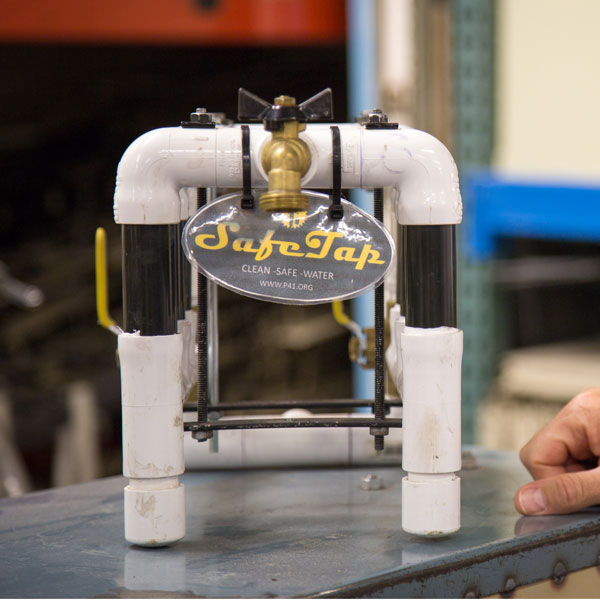
A group of inmates is doing their part to help change that. Inmate crews at the Washington State Penitentiary’s Sustainable Operations Lab (SPL) transform discarded and donated materials into usable items such as refurbished bicycles and furniture. The lab’s latest venture is a new type of water filtration system that will be sent to developing countries plagued with waterborne illnesses.
The SafeTap water filtration system is the brainchild of Andy Pierce, a former plumbing contractor who founded the California-based non-profit, Project 41. A volunteer humanitarian trip to Haiti following a deadly earthquake in 2010 inspired Pierce to start the organization. He’s taken subsequent trips to developing countries worldwide that often have hospitals and health clinics where water supplies are contaminated with harmful bacteria.His humanitarian work involved installing large-scale water systems. While he was doing this, he came up with the idea of creating a small, portable water filter made from pipes, fittings and valves. The filters are stuffed with hundreds of tiny straws made of a hollow-fiber membrane that blocks bacteria. The SafeTap devices can be connected to existing water filtration systems to produce clean water. His invention can filter up to three gallons of water per minute.“The Sustainable Operations Lab was just a huge answer to prayer,” Pierce said. “I was impressed with how well these guys have taken up the cause and keep pushing forward toward excellence and refining the (assembly) process. I’m really blown away.”
Impact of Partnership
The partnership between Pierce and the penitentiary resulted from a chance meeting at a national conference last year on environmental sustainability. The conference, held in Albany, Ore., had dozens of vendors from around the country. Pierce was one of the exhibitors.
Photo by Ricky Osborne.
Christopher McGill and Robert Branscum, two correctional specialists who oversee the penitentiary’s Sustainability Practices Lab, stopped at Pierce’s booth and learned about the SafeTap system. At the time, Pierce was running his plumbing business by day and building SafeTap units at his home by night, but production time was slow, McGill said. “That’s when I told him about the Washington State Penitentiary’s Sustainable Operations Lab.” For the past few months, a crew of nine inmates has been assembling SafeTap water filtration systems. Project 41 funds the materials with donations from a private foundation, Pierce said. Pierce ships the materials to the penitentiary. Inmates assemble the filtration systems. Once assembled, the systems are shipped to countries in need of clean water. Inmates have assembled more than 150 SafeTap units. Thirty-five of the units have been sent to various countries, including eight to Puerto Rico to assist with Hurricane Maria relief efforts. A total of 115 units are heading to the island of Tortola, in the British Virgin Islands and more are headed to the East African Republic of Uganda and Ghana.
Sustainable Operations Lab’s Kieth Parkins has transformed his life sentence into a life of service. He expresses his empathy for families needing clean water by building water purification systems that will meet their needs. Photo by Ricky Osborne.
While the SafeTap systems are saving lives overseas, the partnership is transforming lives at the penitentiary. Kieth Parkins, 49, is serving a life sentence for multiple robbery convictions. He knows his actions in prison won’t have any impact on the length of his sentence, but the project has helped him find something meaningful behind bars. “As a prisoner, I have always felt like I was a drain on society,” Parkins said. “But now, through the Sustainable Operations Lab and the water department, I am able to be a part of something that is literally saving lives throughout the world. In the process, it’s saving my life as well.” Editor’s note: The SafeTap water filtration system was also a finalist in the 2017 Chasing Genius contest, sponsored by National Geographic. Entrants competed against other groundbreaking humanitarian projects for a cash prize. Watch the video entry with inmate interviews.
By Bethany Shepler, SPP Green Track Coordinator
Group photo of program sponsors Jonathan Fischer and Ron Benjamin, professional beekeeper Mona Chambers, and a class of inmate beekeepers. Photo by Ricky Osborne.
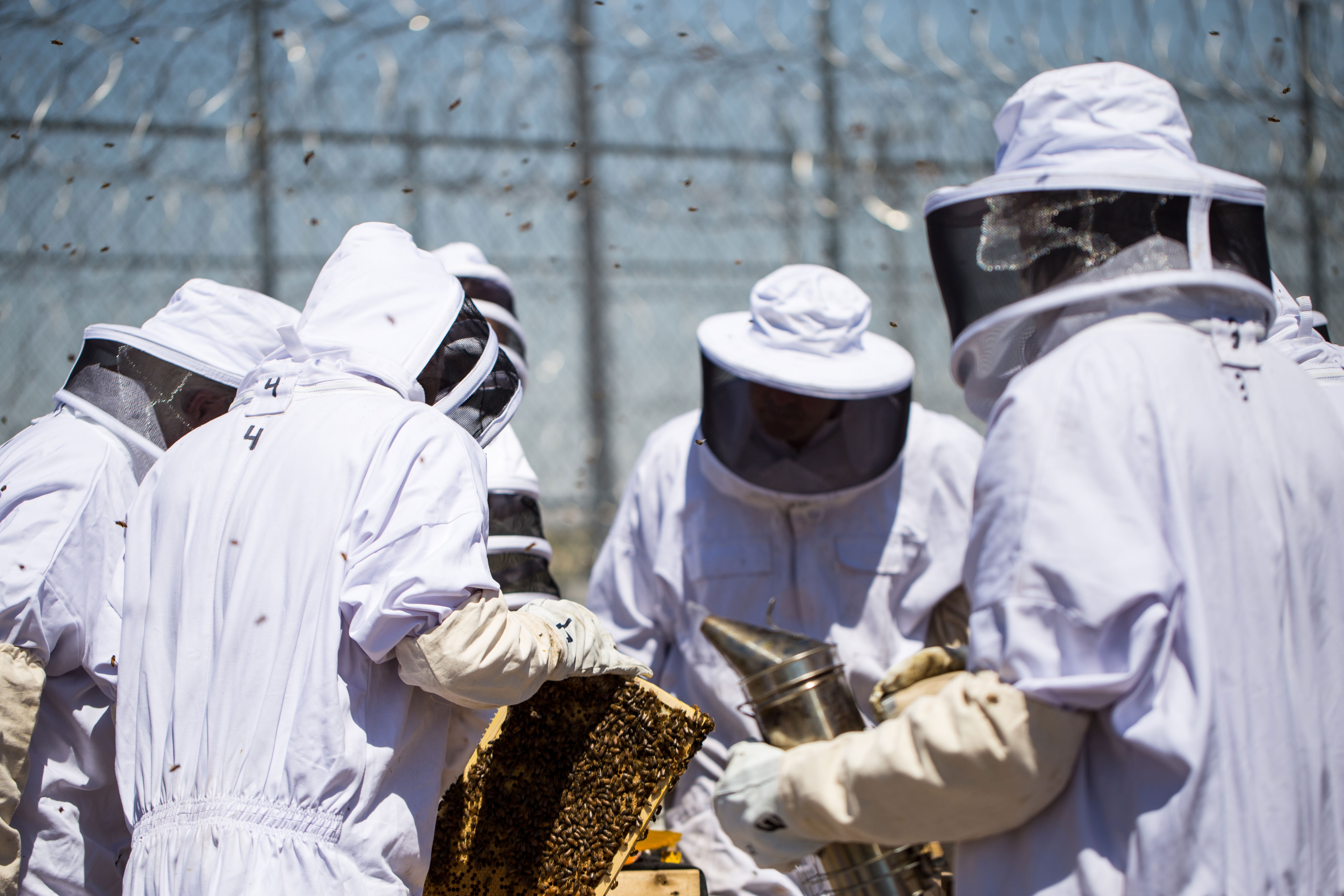
Amid the razor wire and blocky buildings of the Washington State Penitentiary, you might be surprised to see beautiful blooming flowers and thousands of bees busily bumbling through their work. From catching feral swarms, to breeding their own queens, the beekeeping program at Washington State Penitentiary (WSP) has established themselves as a successful and inspirational model.
The program began about 5 years ago when three feral hives were discovered on the grounds. Some of the staff was interested in raising bees and contacted Rob Coffee, an experienced beekeeper. Unfortunately, those first few hives didn’t last the year, but still it was enough of an introduction to catch the interest of staff and inmates.
Over the years, there have been staffing changes and many generations of bees have come and gone. Rob Jackson, now Associate Superintendent, first pushed for the bee program when he noticed those feral hives on site. These days the program is run by Jonathan Fischer and Ron Benjamin, both corrections staff and experienced beekeepers. Last year, a professional beekeeper and founder of See the Bees, Mona Chambers, donated her time to come teach a class of beekeepers at WSP; since then she has kept in contact with them monthly and has supported program innovations such as natural, effective ways of mite control. The program also receives some input from the same Master beekeeper (from Millers Homestead) who supports the beekeeping program at Airway Heights Corrections Center.
A class at WSP working with bees. When asked about the beekeeping course, one student said “I love it. It’s so exciting. Honored to be a part of it, really. If they were going to transfer me next to my family, I’d tell them to wait until this was done.” Photo by Ricky Osborne.
Jonathan and Ron teach WSP’s class to certify inmates as apprentice beekeepers has 15 slots, and clearly this isn’t enough to meet demand – there were 90 inmates who wanted to take the class this year! The course is split between in-class sessions and hands-on working with hives. Their goal of the program is for inmates to gain sufficient experience and journeyman level-certification so they could teach the classes themselves. Even in the early days of the bee program, staff wanted this to be a program that inmates could be fully involved in and eventually run.
Currently, WSP has 12 healthy hives, and that’s even though only 5 made it through the winter. To boost their numbers, they catch feral swarms or buy packages of bees. The one thing that WSP won’t buy are queens—they can rely on Ron Benjamin’s experience as a commercial beekeeper in which he learned how to breed queens. By breeding their own queens, they can choose to favor certain traits and genetics beneficial to their environment.
A class of students, program sponsors Jonathan Fischer and Ron Benjamin, and professional beekeeper Mona Chambers inspect the hives before opening them to check on WSP’s bees. Photo by Ricky Osborne.
The WSP beekeeping program’s main goal is to help incarcerated individuals build skills as productive members of society, but they have many other things they want to accomplish, too. They want to educate inmates and staff about the beekeeping crisis on the west coast, and do their part to reverse the bee shortage; they want to give inmates opportunity to experience the serenity that comes with beekeeping; and—above all—teach inmates a marketable skill to have when they’re released.
As the season wraps up, WSP will harvest their honey and package it in jars that are decorated in a seal designed by this years’ graduated beekeepers. Once they finish harvesting, they will begin to wind down for the winter. We at SPP look forward to more continued success and inspiration from the busy beekeepers of WSP.
An inmate beekeeper inspects a frame outside of a hive at WSP. Photo by Ricky Osborne.
By Dr Phil Thomas PhD. FRSA. FIIEG. MCIEEM, Ecology Lead for the UK Ministry of Justice Estates Cluster
I often ask myself the question: will the habitats and amazing native species still be here, and will they be here when my children’s children are grown up? Will they be reflecting on what could have been?
Where does the Ministry of Justice (MoJ) and Her Majesty’s Prison and Probation Service (HMPPS) fit into nature and wildlife, and how does it reflect in its aim of serving the public by keeping in custody those committed by the courts? Our duty is to look after inmates with humanity, to help them lead law-abiding and useful lives whilst in custody and following release. I’m glad to say that MoJ and HMPPS take these responsibilities seriously.
HMPPS estate is one of the largest within the MoJ portfolio, and the MoJ Estates Cluster is one of the largest built and non-built rural estates in UK Government. Thus, we face quite a challenge in protecting the property’s native flora and fauna. MoJ and HMPPs takes this responsibility seriously as well, so much so it implemented one of the first UK Government Department Biodiversity Action Plans (BAPs). This goes some way to supporting the UK’s commitment to halting species’ decline, as well as fulfilling MoJ’s and HMPPS obligations to a sustainable and compliant Government estate.
A wealth and diversity of wildlife lives and thrives around individual prison sites; with over 147 prisons across the HMPPS estate in England and Wales, the diversity of wildlife is quintessentially very rich. There are nine prison sites which are nationally important Sites of Special Scientific Interest (SSSIs), including two European designated sites and two sites which are internationally designated for their wetlands and wading birds. With another 39+ sites of county and local biodiversity significance, the MoJ and its MoJ Ecology network are significantly challenged.
Social and Community Impacts
The MoJ Ecology network and HMPPS recognises that the actions and targets it has set for biodiversity can only be achieved through active support from corrections’ staff, and prisoners and local partners. By encouraging staff and prisoner involvement in all aspects of biodiversity within its estate, and through local community projects, HMPPS and the MoJ Ecology network can broaden its sustainable operations’ and social impacts agenda.
HMPPS and the MoJ Ecology network believe it’s important that all members of staff and prisoners should have access to green space and the natural world, for enjoyment, education and wellbeing. Nature’s biological diversity remains a source of constant enjoyment in people’s lives. Both the MoJ Ecology network and HMPPS aims to build upon its past successes in this field, to help form and bond closer links with prisoners and those that work in the local community promoting and protecting wildlife. Forming new partnerships and locally driven initiatives will aid in delivering BAPs, protecting important and declining wildlife, and in addressing other important social, health and wellbeing issues for inmates and staff.
The MoJ Ecology network and HMPPS consider that active management of its designated and wildlife significant sites and natural green spaces can improve the wellbeing of individuals, encourage Restorative Justice, and address offending behaviour programmes for prisoners. As the MoJ Ecology network and HMPPS works alongside such partners as Natural England, the Royal Society for the Protection of Birds, Bumblebee Ecological Conservation Trust, County Wildlife Trusts and other nationally recognised wildlife groups and various academics, it demonstrates how wildlife and life’s rich tapestry can have widespread benefits. This includes communities beyond the prison environments—prisoners can do meaningful work that benefits local communities, and obtain transferable learning and skills that will help them secure stable employment on release.
Broadening the opportunities for nature Ecological Conservation and wildlife protection by developing activities that are enjoyable and inclusive for both staff and inmates enables them to explore and improve the sustainability of their everyday life choices and how they impact wildlife and the outside community. These opportunities are a key tool, in delivering such events and activities as our national BioBlitzes, our national Biodiversity Day and the annual HMPPS Wildlife Award.
The MoJ Ecology network and HMPPS considers that involving inmates in the protection of wildlife, events such as the HMPPS Wildlife Award, and managing priority habitats can give them a sense of accomplishment, a sense of achievement and more importantly, a sense of pride in themselves. Together these feelings and emotions can help prisoners not only get in touch with themselves, but help them become positive and active members of society and their local communities once more.
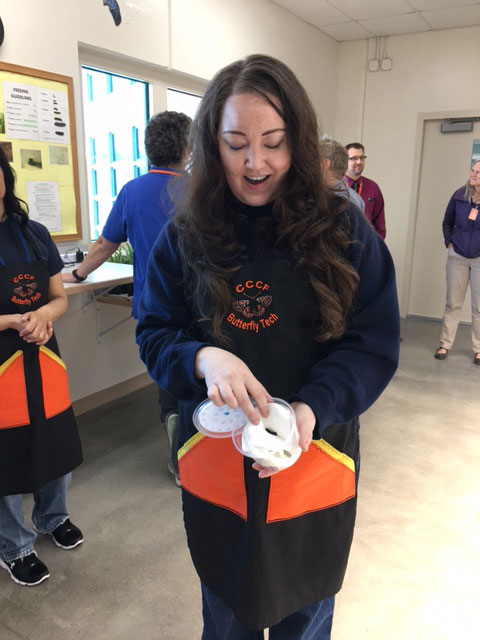
The technicians pose with their larvae, growing in cups under energy-efficient LED bulbs. From left to right: Marisol, Carolyn, Mary, Sarah.Sarah shows how larvae have begun webbing in preparation for diapause.
The excitement generated by the new Butterfly Ecological Conservation Lab at Coffee Creek Correctional Facility is both palpable and contagious to anyone who visits. The buzz began this spring. Oregon Zoo staff began training program technicians to receive egg clusters and to raise larvae. At the same time, staff and inmates – skilled in trades from plumbing to quilting – worked to transform an empty room into a fully functioning, bright, and beautiful lab. The work being done here is groundbreaking: it expands recovery efforts for the endangered Taylor’s Checkerspot Butterfly from Washington to Oregon, and brings butterfly Ecological Conservation work into a medium facility housing unit for the first time.
The technicians’ dedication to the work is reflected in successes so far this season. Their attentiveness allowed them to capture video of the first larvae hatching from their eggs. They enthusiastically welcomed 150 “ninjas” that were overlooked as egg clusters but suddenly appeared as larvae on our host plants. Recently, they accepted the responsibility for care of a single Oregon Zoo butterfly which elected to skip diapause (a period of dormancy, somewhat similar to hibernation), and head straight into pupation and adulthood several months ahead of schedule.
Ultimately, the technicians’ care has resulted in a 95% survival rate, measuring from the time the larvae were first big enough to count to entering diapause. Our program goals include having 500 larvae survive diapause in order to be released to the field next spring; with 935 healthy larvae currently ready to head into the overwintering stage, we are optimistic we will meet this goal!
Marisol shows a lab visitor how larvae climb to the lids of their cups to bask in the light.
Staff and technicians alike are deservedly proud of their work and of the lab itself. They actively seek opportunities to share their space and their new knowledge. They host tours, speak about the program at Toastmasters gatherings, and participate in special activities such as CCCF’s annual Through A Child’s Eyes event and a recent science lecture and media visit. Technicians share larval development with other women on their unit by displaying photos and information on the lab windows. In the technicians’ words:
“When I go to our butterfly lab, I feel a sense of peace in a world of chaos. I have a rare opportunity to sustain the life of an endangered species, which gives me a unique reward of being able to give peace back into the world.”
Sarah
“This program gives me an opportunity to give back to the Earth and not take things for granted.”
Marisol
“The Butterfly Program has been very beneficial to me as I know I’m doing something good for the environment. I also love the opportunity to work with a wonderful team!
Mary
“To be involved in this program means I am given the opportunity to be involved in my community here at Coffee Creek as well as an extension to the outside community through our partnership with the Oregon Zoo, ultimately helping to change Oregon’s environment one butterfly at a time.”
Carolyn
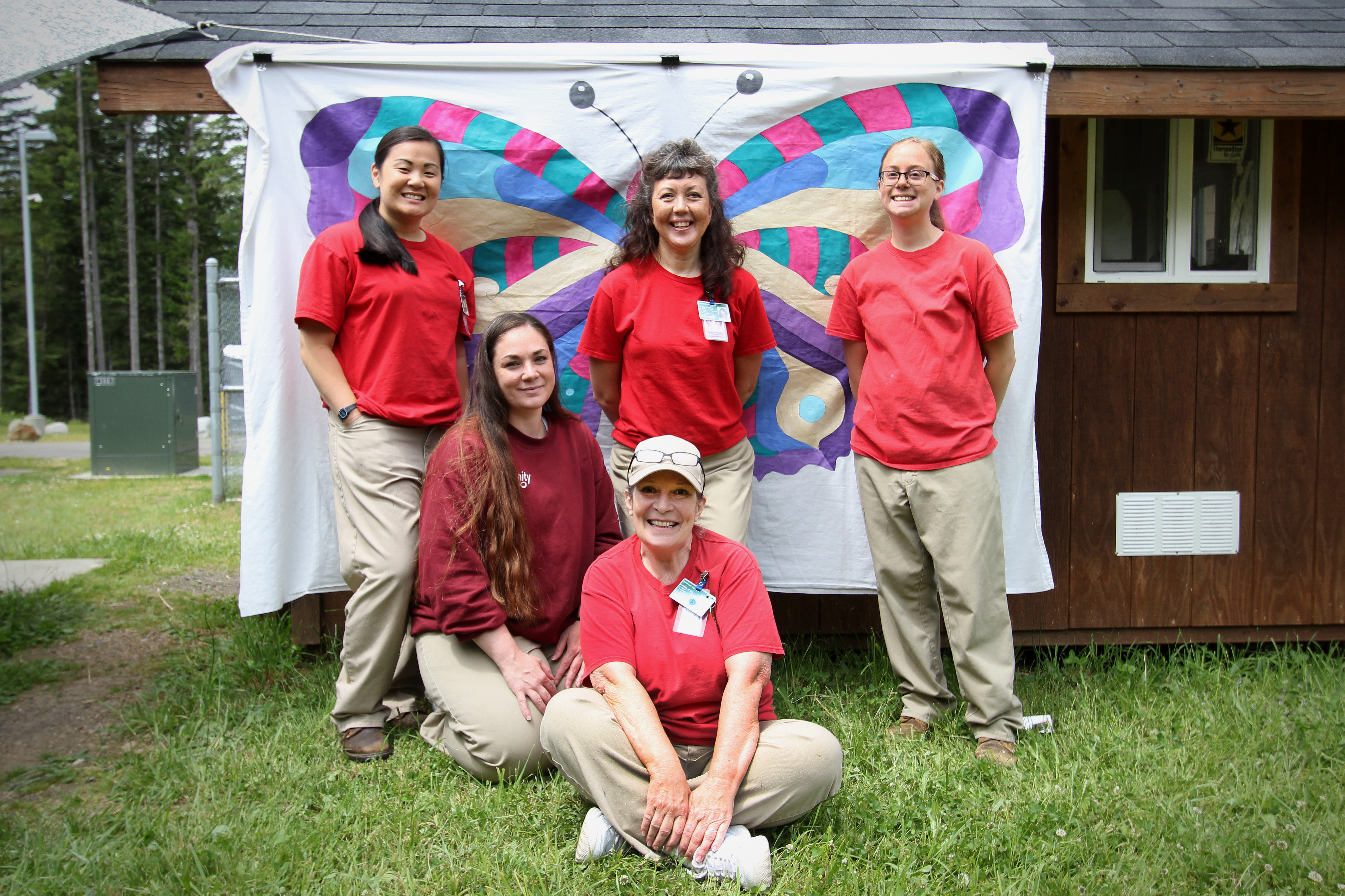
The butterfly crew stands under a quilt created for the lab by Oregon Corrections Enterprises quilters. From left to right: Marisol, Ronda, Mary, Sarah, Carolyn.
Text by Liliana Caughman, outgoing SPP Workshop Coordinator
Photos by Mark Sherwood and Kelly Peterson at SCCC
Liliana poses with Workshop students on her last day at SCCC. These two were particularly energetic and engaged, always participating in everything: they asked great questions, brought insight to environmental discussions, and were willing to hold snakes when needed!
It is strange how the past two years have flown by and it’s hard to believe that my time visiting prison has come to an end. It is stranger yet that many of the people I interacted with in prison will remain there for years to come. I can only hope that my small efforts made an active difference in the lives of the students, those who I saw month after month in SPP’s Environmental Workshop Series.
Mark Sherwood was a lively and dependable partner at SCCC. He bridged the gap between SPP and the incarcerated students and made sure the workshops were successful for everyone.
To me, the story of working with the Sustainability in Prisons Project (SPP) is one of cooperation, patience, and unlikely friendships.
I was troubled by prison in many ways and became more cognizant of institutional discrimination. At the same time, I also encountered such beauty. I have seen in-prison gardens expand to cover acres and beehives spread across the state. I have seen a room of 80 grown men geek-out over octopuses and vultures and climate science. I have seen hardened corrections officers shift to a focus on rehabilitation and education and understanding. I have seen how—given sufficient opportunity—hope, happiness, progress, and creativity can flourish in any environment.
SPP’s work at SCCC could not happen without the ongoing support of Chris Idso. Here he says goodbye to Liliana. Chris is already so excited to get to know Erin and create more positive changes, like hosting workshops in the visiting room!
These valuable experiences will never leave me. As I continue my academic path, I will not forget about those behind bars or other vulnerable populations who are suffering. However, I will also remember the good people working in these institutions who are partners, fighting for change in the ways they know how. With all parties being valued, challenged, and heard, I know great things can happen.
Now the time has come for me to say goodbye and thank you to SPP and everyone with whom I partnered. I am proud to have been a part of this unique endeavor and look forward to watching it continue to grow.
I am also thrilled to pass on my position as Workshop Series Coordinator to Erin Lynam. With a focus on policy and passion for changing our system of incarceration, I know she will breathe new life into the program and continue its evolution.
Cheers!
Text and photos by Keegan Curry, SPP Taylor’s Checkerspot Butterfly Program Coordinator
(Left to right) Jessica Stevens, Nicole Alexander, Cynthia Fetterly (seated), Susan Christopher, and Alexis Coleman pose in front of their original artwork. Ms. Stevens and Ms. Christopher painted this banner to welcome Girl Scouts Beyond Bars to the butterfly lab for a day of activities, including a unique Taylor’s checkerspot merit badge designed by Ms. Alexander.
Inmates at Mission Creek Corrections Center for Women (MCCCW) continue to amaze us. Each year, a group of dedicated technicians raise and release thousands of federally-endangered Taylor’s checkerspot butterflies. Not only do these technicians follow rigorous laboratory protocols, they develop their own personal expertise and remain adaptive to the myriad challenges of animal husbandry.
This year we were lucky to have three returning technicians on the team. Jessica Stevens, Cynthia Fetterly, and Susan Christopher have completed multiple seasons in the butterfly lab and they have an in-depth understanding of each life stage. Their experience has taught them how to read these animals down to the finest details, like determining the “instar” of a growing caterpillar or predicting how the weather might influence adult mating behavior. Returning technicians play a crucial role, and it is equally important to recruit new participants. This winter we welcomed Nicole Alexander and Alexis Coleman to the butterfly crew and they began their crash course in Taylor’s checkerspot rearing. By the end of the flight season, Ms. Alexander and Ms. Coleman were well-versed in everything from pupation to egg collection!
Thanks to all of the staff from WA Department of Corrections and MCCCW who work tirelessly to coordinate this program. And of course, we wouldn’t be here without support from the Oregon Zoo and Washington Department of Fish & Wildlife. It means a lot to have zookeepers and biologists coming to MCCCW and giving incarcerated technicians the confidence to work with this fragile and beautiful species.
Take a look at these photo highlights from the past few months.
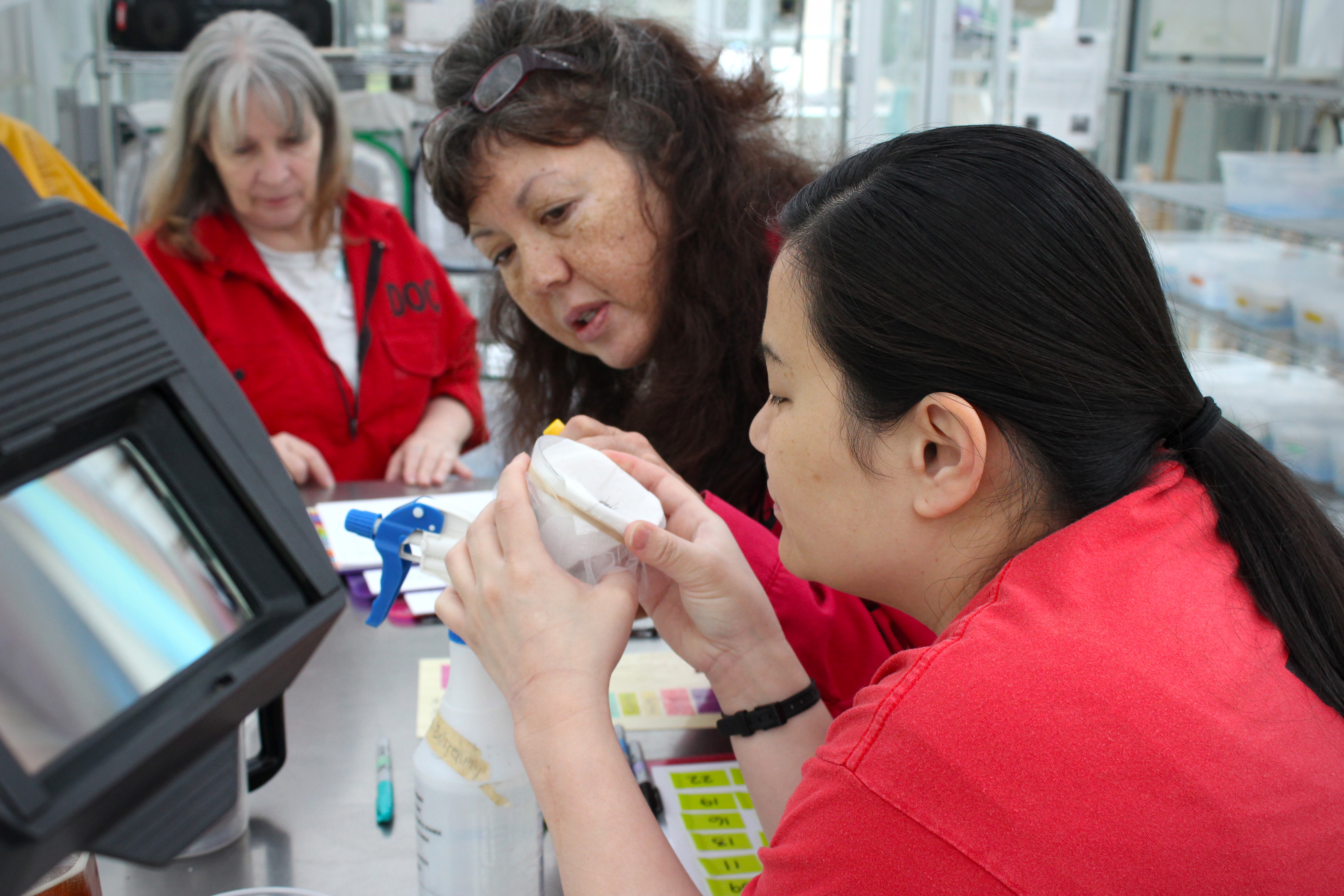
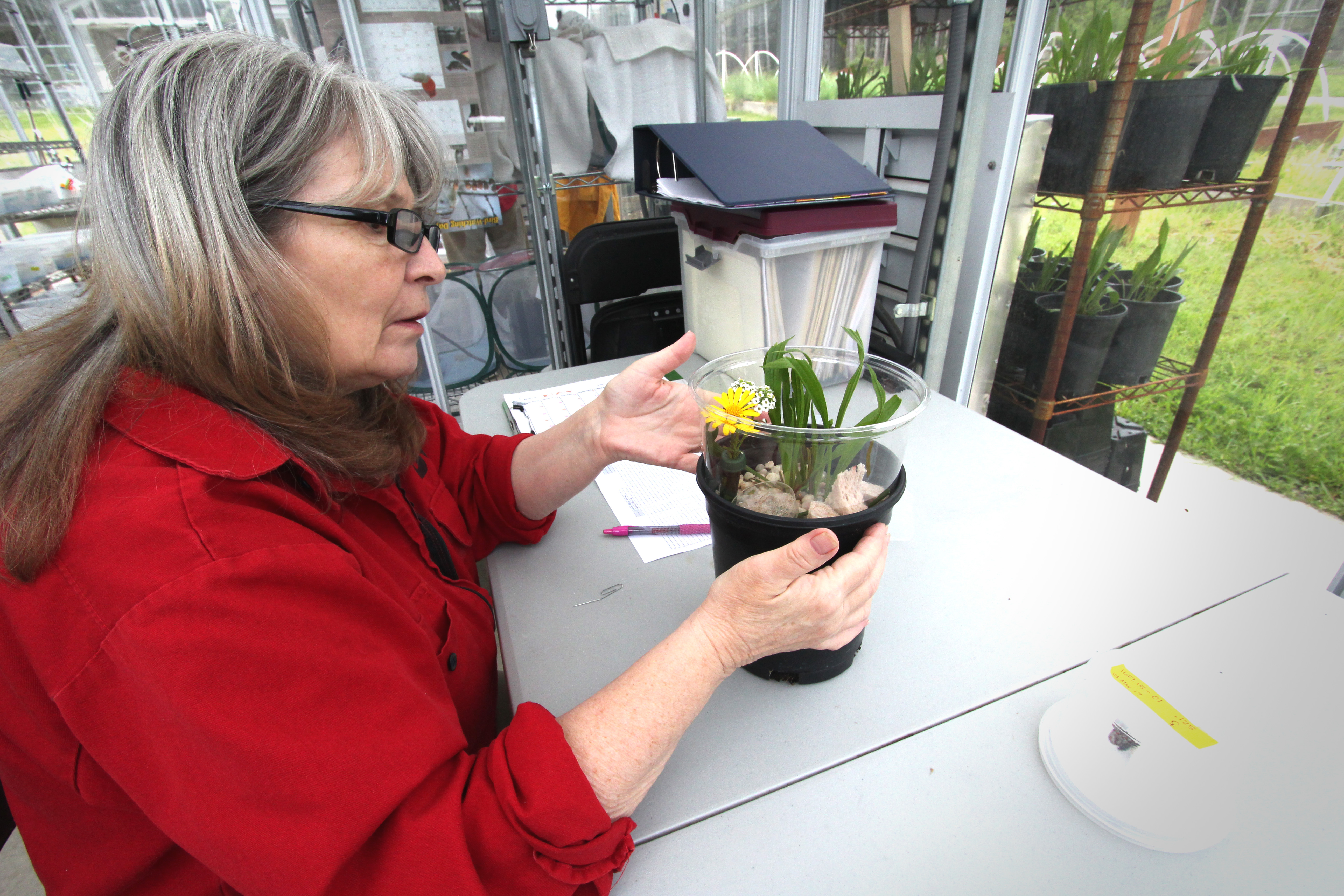
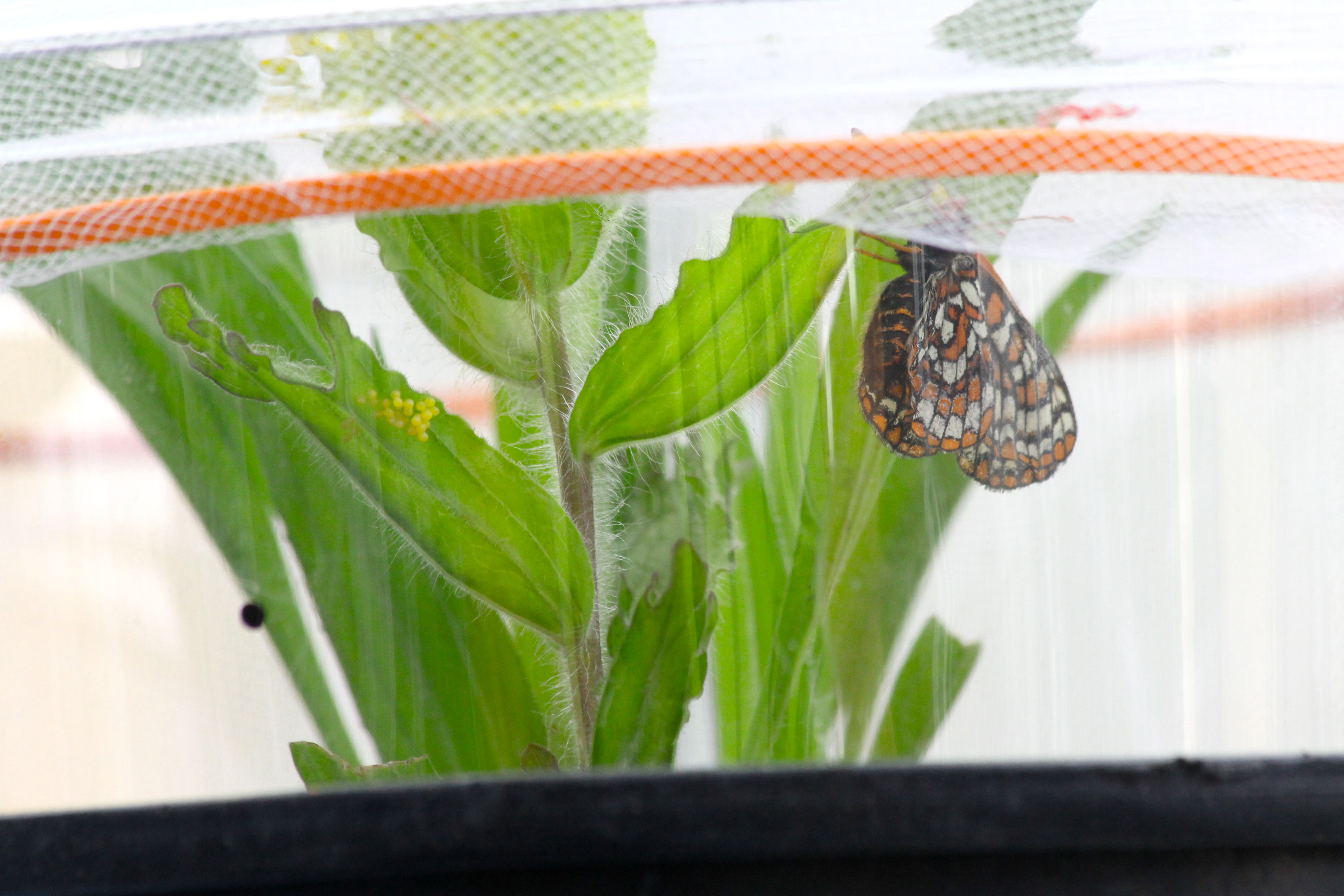
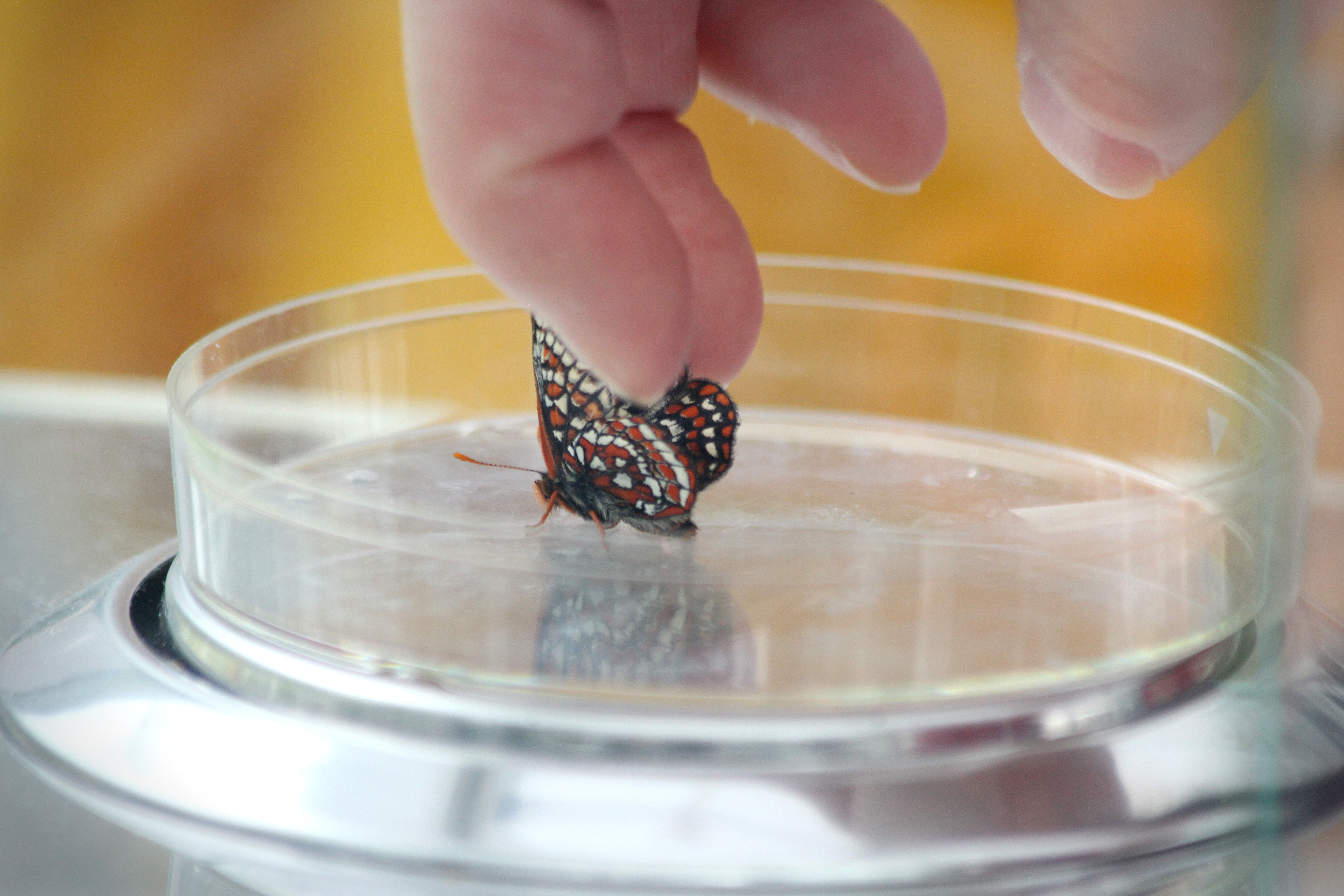
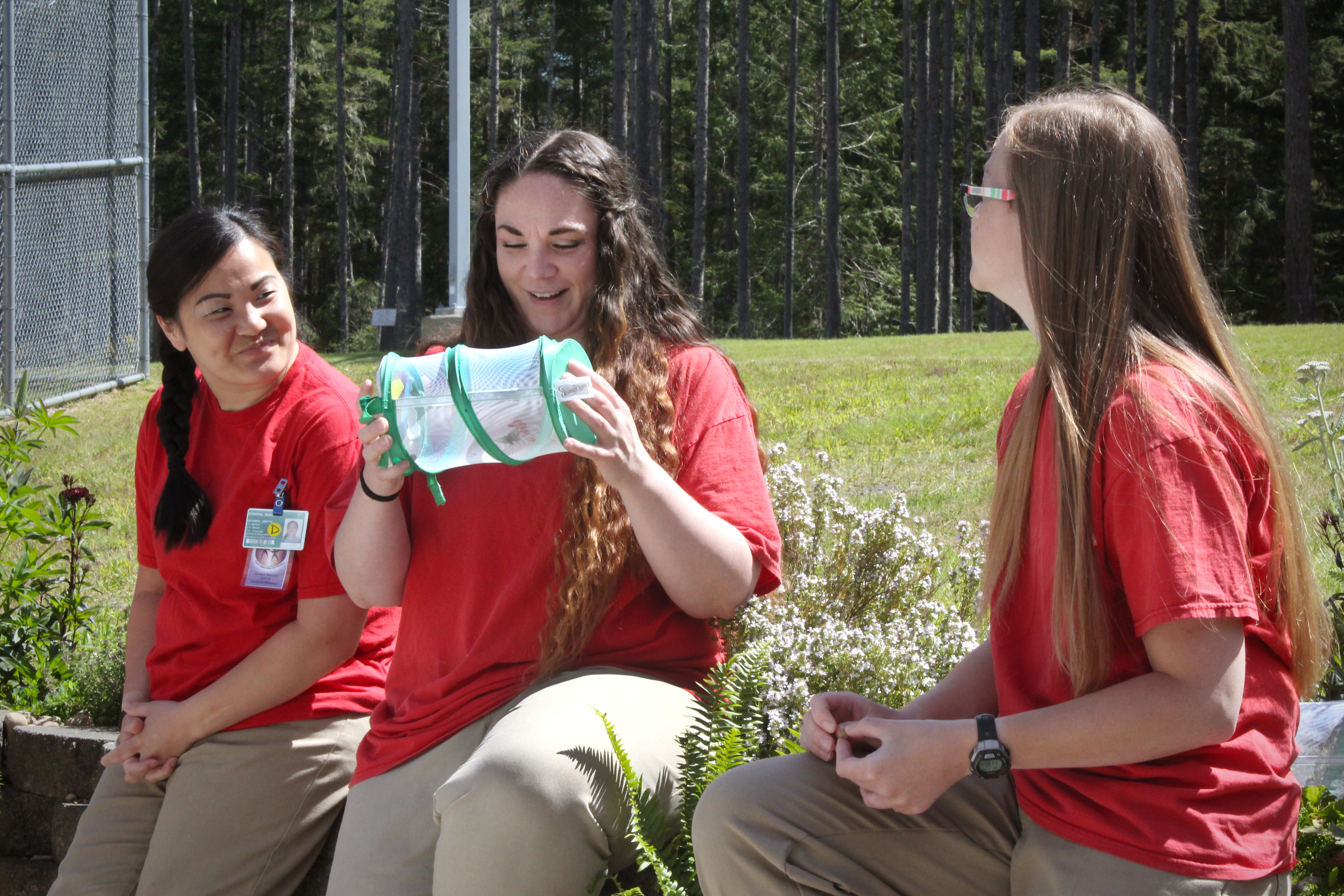
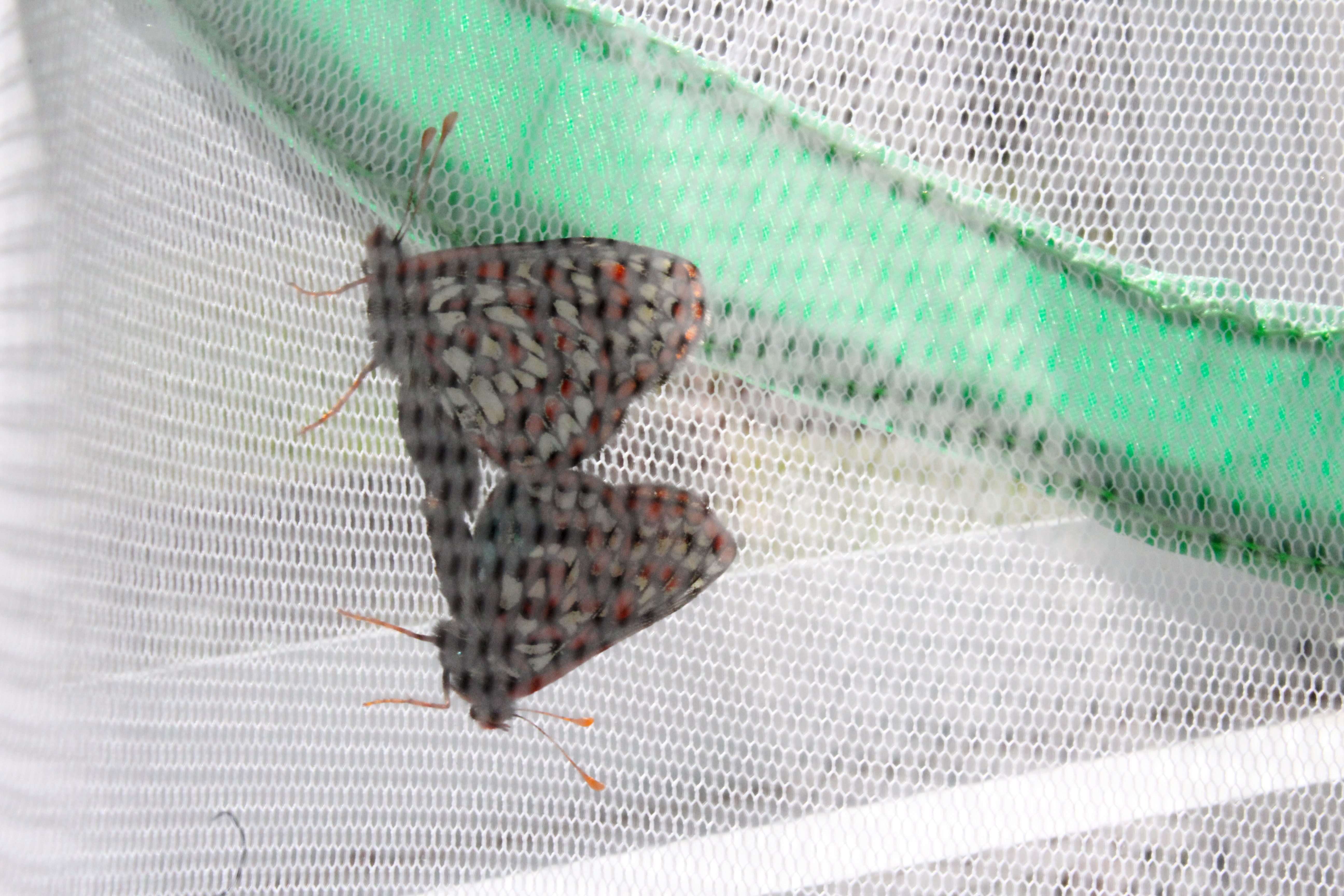
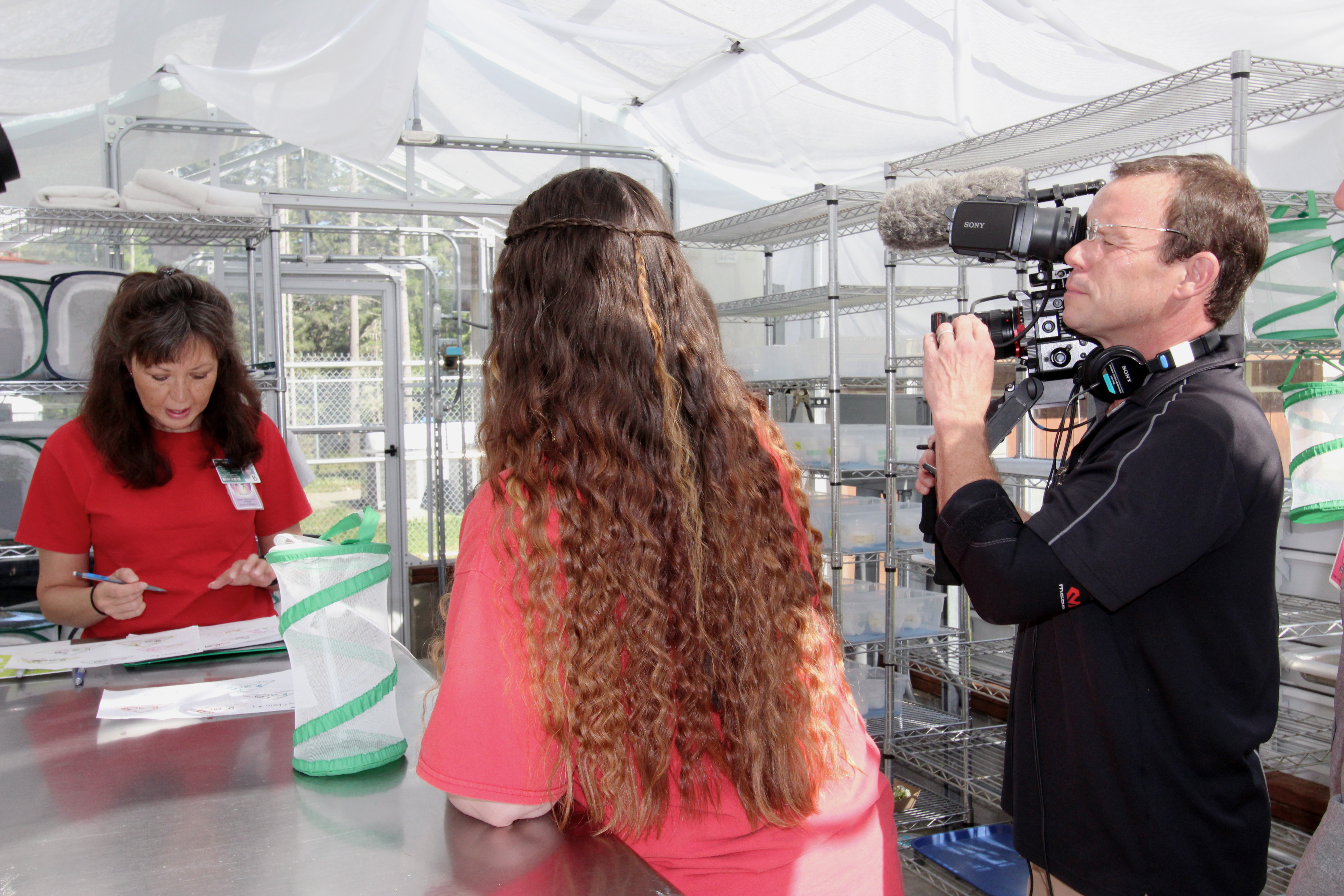
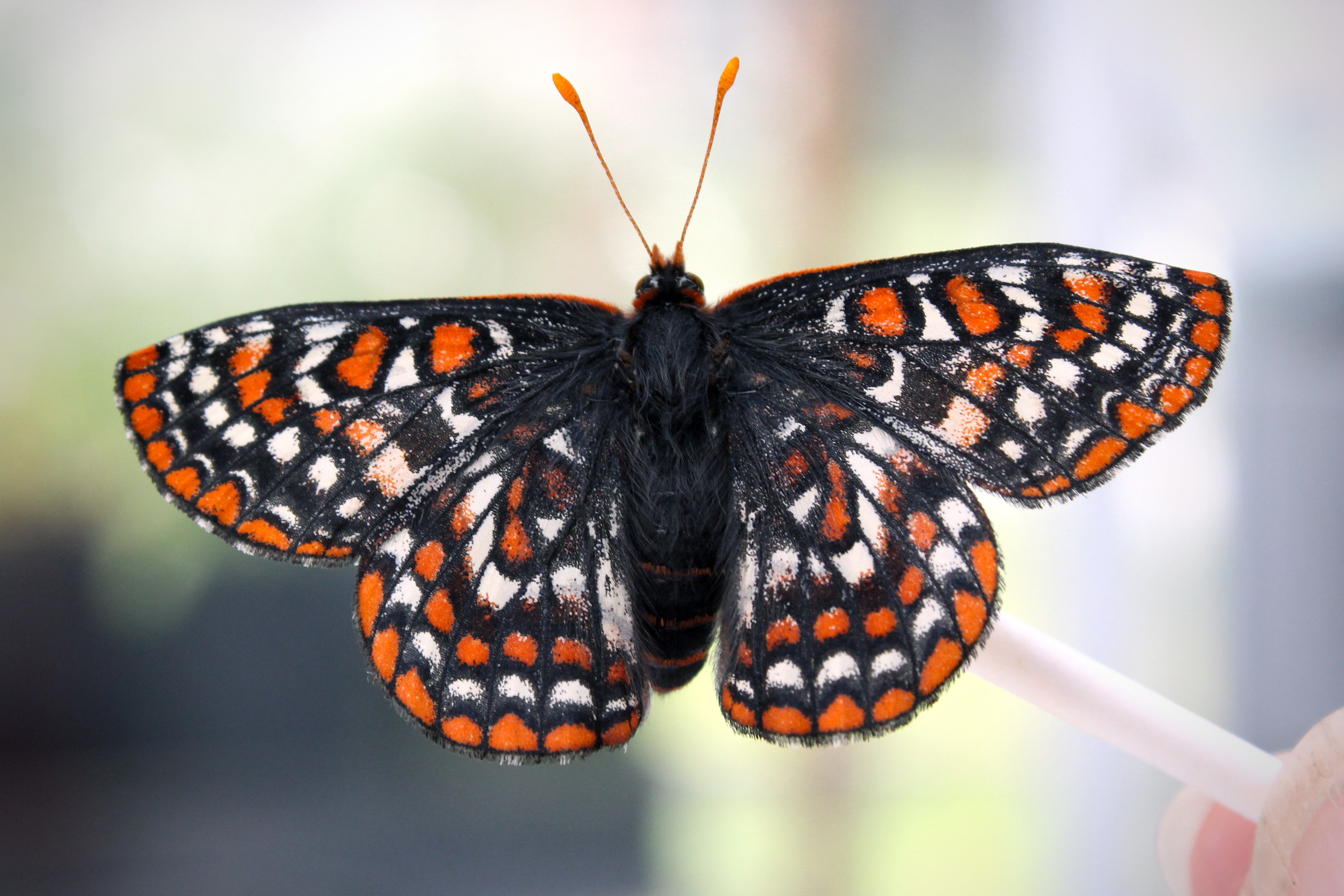
Taylor’s checkerspot caterpillars in their newly-formed cocoons. They remain in this state for up to three weeks and then emerge as butterflies (also known as “eclosion”).(Left to right) Cynthia Fetterly, Susan Christopher, and Jessica Stevens inspect a pupa to see if it is ready to eclose.After wiggling free of their cocoons, two adult butterflies dry their wings. It can take several hours after eclosion before they are ready to fly.Cynthia Fetterly searches for butterfly eggs. She has to check every inch of the plant and down in the rocks at its base. It’s a tedious but crucial task.This female just laid a fresh cluster of eggs (the tiny yellow orbs on the leaf to her left).(Left to right) Susan Christopher teaches new technicians Alexis Coleman and Nicole Alexander how to safely handle adult checkerspots. Technicians inspect the size and shape of the abdomen to determine whether butterflies are male or female.All adult checkerspots must be weighed and measured. Notice how this technician grasps the butterfly with the sides of her fingers, avoiding harm to its wings.Jessica Stevens keeps a watchful eye over adult breeding tents.Mottled sunlight and a warm breeze are a checkerspot’s ideal conditions.The adult life stage is a critical period in the captive rearing program. Technicians conduct dozens of breeding introductions each day, keeping track of each individual’s “matriline” in order to maintain genetic diversity.Breeding Taylor’s checkerspot takes patience. After hours of waiting and adjusting environmental conditions, these two finally decided to mate.Susan Christopher leads a tour of the butterfly lab for a documentary crew from PBS Nature. Photo by Kelli Bush.PBS Nature gathers footage of Susan Christopher and Nicole Alexander double-checking their breeding data. Photo by Kelli Bush.It’s hard to deny the charm of the Taylor’s checkerspot butterfly. We extend our gratitude to the technicians at MCCCW who continue to prove that incarcerated people can make a difference in conserving biodiversity.

























Once a year, SPP reports on all things sustainable happening in Washington State Prisons.