Text and photos by Erica Benoit, SPP Environmental Workshop Series Coordinator
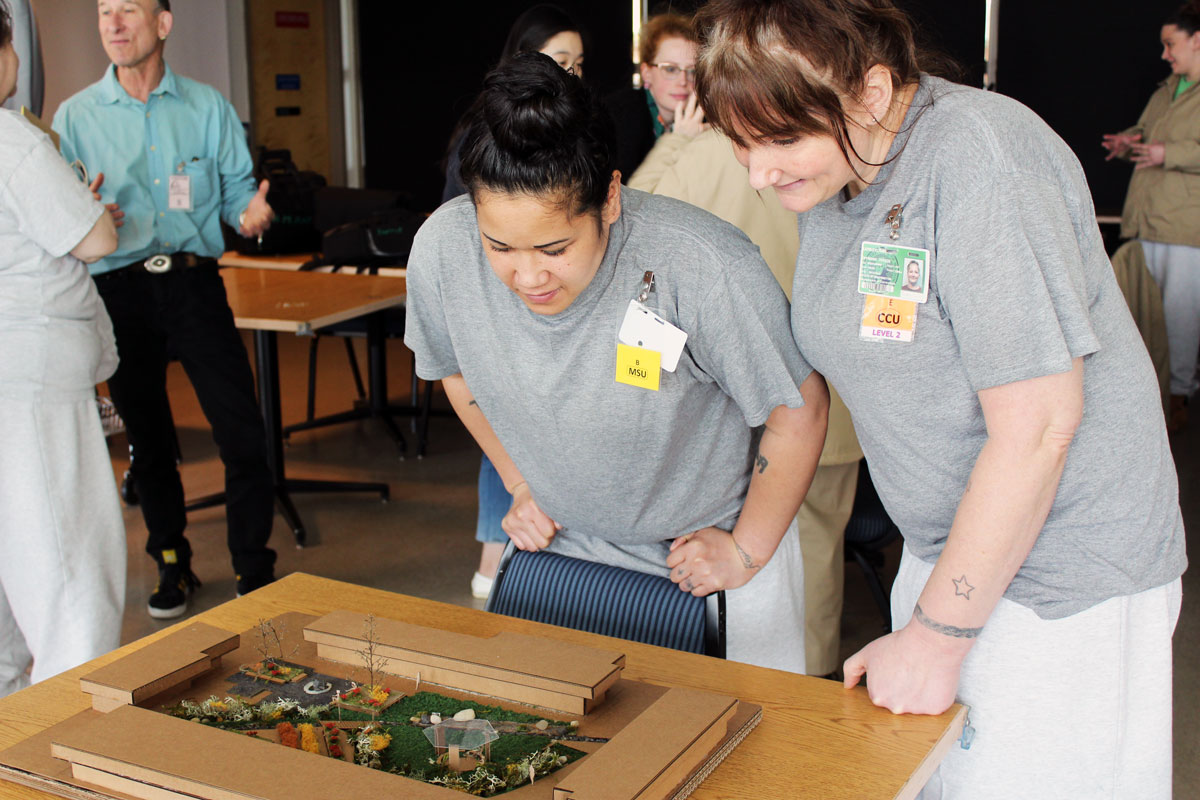
More than 70 students filled the workshop classroom at the Washington Corrections Center for Women (WCCW) in Gig Harbor to engage with Professor of Landscape Architecture Daniel Winterbottom and his students from the University of Washington (UW) College of Built Environments. The students enthusiastically presented six proposals for a re-envisioned prison landscape, one that offers many ecological, psychological and emotional wellness.
Professor Winterbottom first came to WCCW early in 2016, along with Dr. Barb Toews of UW-Tacoma. Both academics saw potential for building restorative landscapes at the prison, for the benefit of both incarcerated individuals and prison staff. They also found willing partners among WCCW’s leadership, particularly Associate Superintendent Felice Davis, Facilities Manager Rod Coberly, and Superintendent Jo Wofford. Even so, it took three years of persistence before Professor Winterbottom had the go-ahead to make the prison the topic of his Therapeutic Master Plan Studio class.
Last month, he and his students presented their recommendations to WCCW’s leadership, which were met with further support and enthusiasm. The next step was to get feedback from the incarcerated individuals, the folks who might be most affected by the potential project. Luckily, there was an opening in the workshop series calendar, creating the perfect opportunity to bring everyone together!
The student groups, with architecture models and posters in hand, presented projects focused on designing a nurturing and healing environment as an exercise of rethinking the landscape of incarceration.
They proposed creating places that stimulate the senses, and that offer both respite and engagement through the garden. Each proposal offered different approaches and methods, but all were intended to create a more humane place for both residents and staff.
Workshop students were especially respectful of the time and effort the UW students put into their projects, and their comments and questions reflected that appreciation.
Overall, workshop students were engaged and excited to hear about the potential to transform their built living environment.
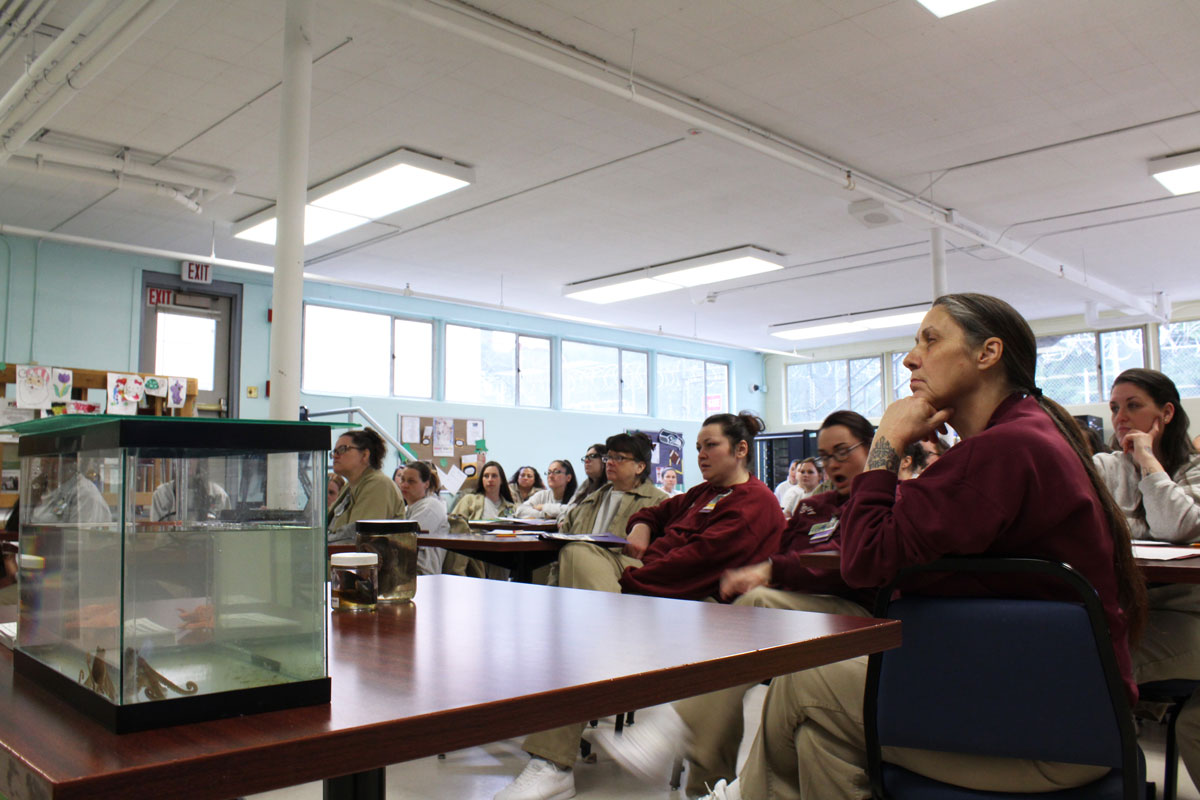
Are octopuses smarter than a 5th grader? Are you? How do we measure intelligence? In a June workshop at the Washington Corrections Center for Women (WCCW), Rus Higley and Aeriel Wauhob from MaST Center Aquarium posed these questions to a group of incarcerated students who are part of the Freedom Education Project Puget Sound (FEPPS). FEPPS is a non-profit organization that offers Associates of Arts and Bachelor of Arts degree to incarcerated people at WCCW.
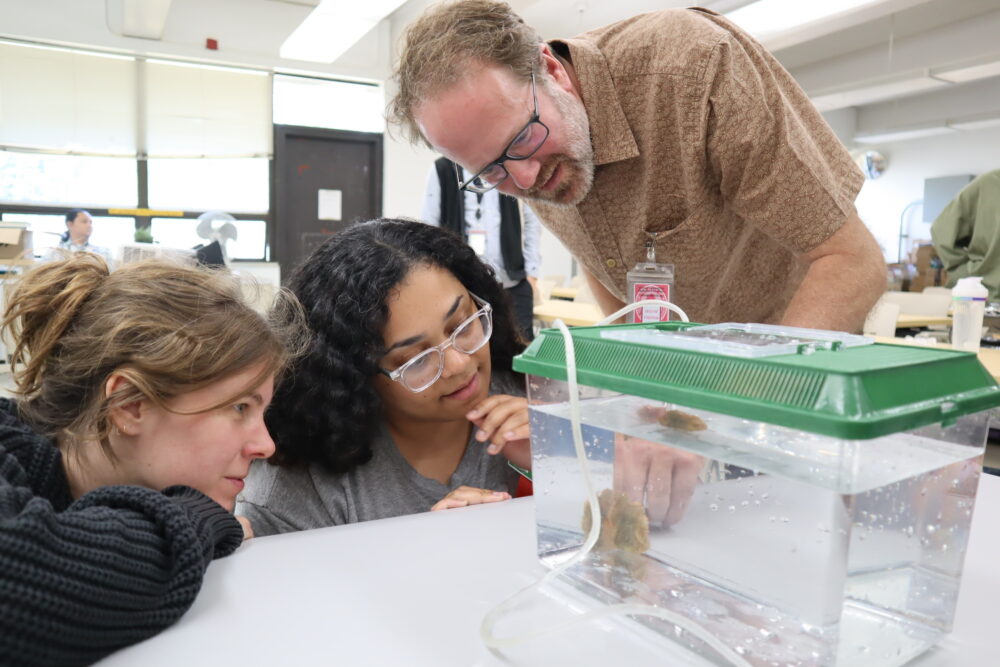
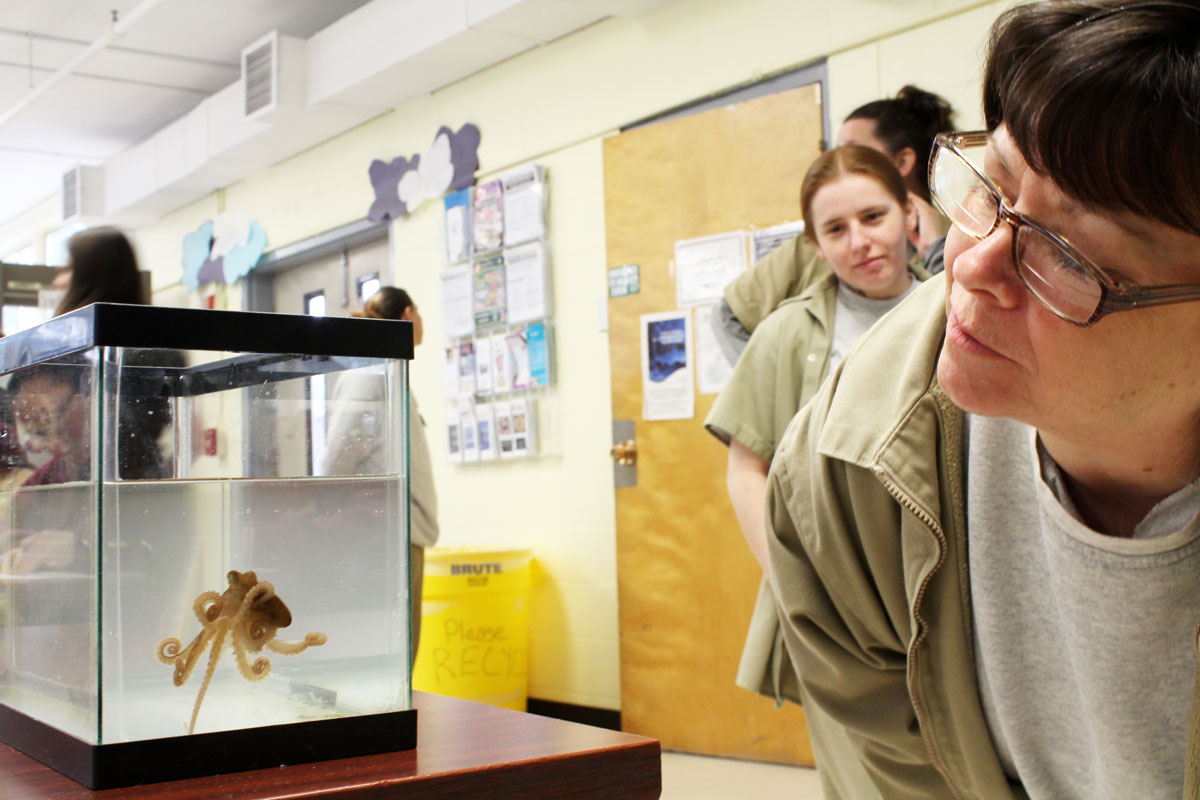
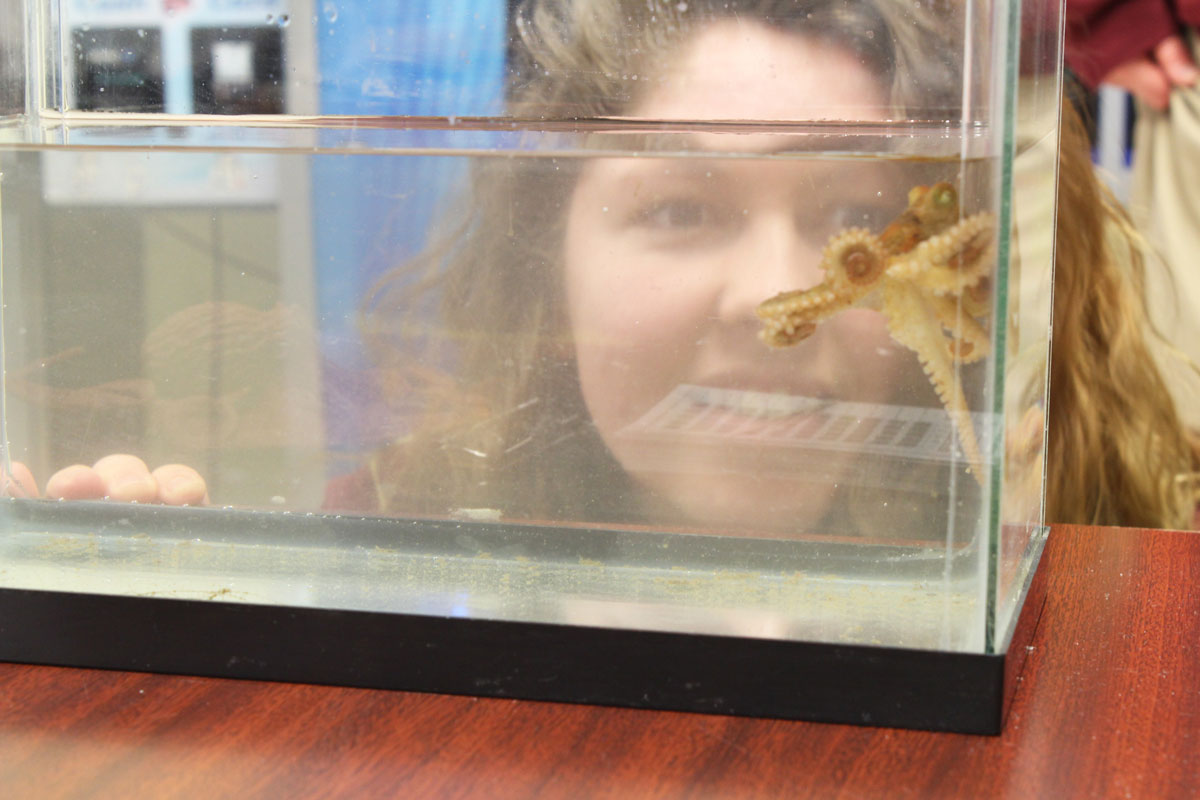
In a fantastic presentation given by Higley, students watched amazing videos of camouflaged octopuses, learned about species native to the PNW, and even got to meet a live juvenile Pacific red octopus!
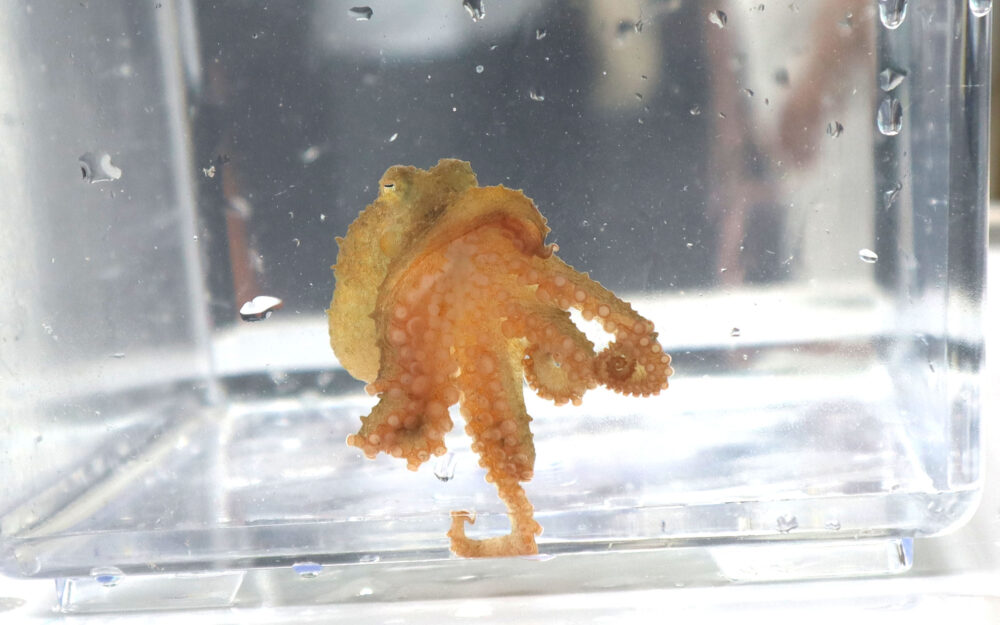
Russ Higley from the MaST Center Aquarium in Tacoma explains octopus anatomy. Photo by Emily Passarelli.Red pacific octopus (Octopus rubescens). Photo by Emily Passarelli.
Octopuses use tools, have spatial memories and personalities, and engage in play, all attributes that humans consider signs of intelligence. So, ARE octopuses smarter than 5th graders? It’s complicated. While an octopus may not pass a 5th grade multiple choice test, the workshop hosts and participants all agreed that knowing facts on a test was not the best way to measure intelligence, especially for a creature who has nerve cells (like the ones found in our brains) in all eight of its arms!
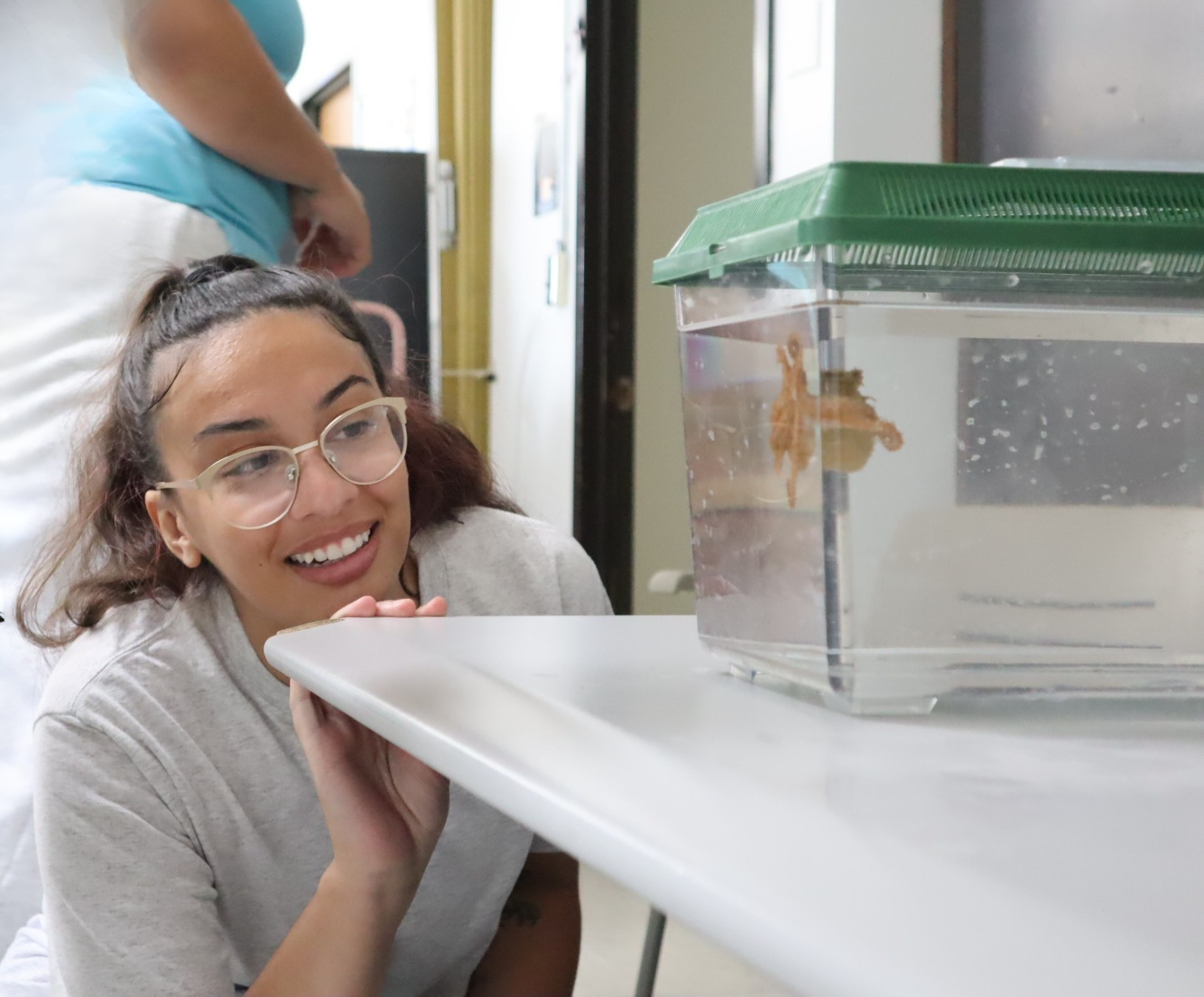
Andrew Campbell from the Freedom Education Project Puget Sound (FEPPS) looks at the Pacific red octopus.Russ Higley (right) points out octopus anatomy to SPP coordinator Anneke Wilder (left) and student Tatiana Baker (middle).Olivia Bebic gets an up-close look at the Pacific red octopus.
As SPP continues to ramp up our workshop offerings, now is a great time to get in touch if you or someone you know may be interested in offering a workshop in a prison facility. Contact Michael Zirpoli at michael.zirpoli@evergreen.edu for more information! Workshops provide fantastic opportunities for community learning exchanges, and they are an integral part of our educational offerings at SPP.
SPP Workshops are starting back up in facilities after a hiatus, and we couldn’t be more excited! Recently SPP kicked off this initiative by hosting its first workshop since pre-pandemic at Washington Corrections Center for Women.
The Introduction to Nature Drawing Workshop was a huge hit! Drawing from her background in scientific illustration, SPP Coordinator and artist Anneke Wilder led the workshop. Students learned about the history of nature drawing and illustration as well as some drawing tips and tricks. The second half of the workshop the students spent some time sketching from books or specimen that were brought in. Some SPP staff even joined in on the fun!
We’re looking forward to bringing in more experts and educators that offer unique learning experiences to incarcerated students.
Kelli Buggs Jones draws a few different specimen. Photo by Emily Passarelli. A student sketches a cedar frond. Photo by Emily Passarelli. Tatiana Baker shows off her drawing of a flower. Photo by Emily Passarelli.SPP Coordinator and workshop host Anneke Wilder gives Michelle Gabel some tips on shading. Photo by Emily Passarelli.Students got to choose from a variety of specimen for drawing subjects. Photo by Emily Passarelli.Student Michelle Nichols and SPP Coordinator Laureen Dulo use images from books as references. Photo by Emily Passarelli.
By Joslyn Rose Trivett and Erica Benoit, SPP at Evergreen Photos by Joslyn Rose Trivett.
A Pacific red octopus uncurls its tentacles as it swims back in forth in front of the class at Mission Creek Corrections Center (MCCCW).
One of the best things that we have been a part of in 2020 was the launch of our workshop series at Mission Creek Corrections Center (MCCCW). Hard to believe it was only a month ago — life is so different today than it was then. Our main focus has to be responding and adapting to the COVID 19 crisis, and still it’s important to let ourselves focus on the good and the positive. For the sake of our partners in prison, we want to continue share some of the magic of nature and environmental education inside of prisons and the partners who make it possible. These programs are so valuable and important to us; we can’t wait to continue to support them inside prison as soon as it’s safe to do so.
Here are some of our favorite images from the first SPP Environmental Workshop at MCCCW, Octopus Intelligence. Rus Higley and Joanne Park of the Marine Science and Technology (MaST) Center at Highline College facilitated an excellent session. Of course the real star of the show was the juvenile Pacific red octopus (the same species but a different individual than the one who visited a 2016 workshop at Stafford Creek…the MaST Center releases an octopus back to the wild when its behavior suggests that it is ready to go.)
Christina Flesner studies the octopus…while it studies her back! Can’t know for sure, but Rus Higley made a compelling case for high levels of octopus awareness and smarts.MCCCW’s Lieutenant visits with the octopus. She has been a solid supporter of other SPP programs at MCCCW as well.Meg Ward studies a preserved specimen.Jasmine Sabourin visits with the octopus. Several viewers showed similar happiness in the octopus’ presence.Two officers stayed for the workshop and appeared to enjoy and appreciate the session as much as the incarcerated students.Students’ questions were one of the best parts of the workshop. Some of the topics they asked about were how octopuses are affected by pollution (a lot), whether it’s possible to tag and track them (possible and really tricky), whether females can opt-out of reproduction, which is a mortal act (probably not), and the quality of life for octopuses in captivity at the lab.
The second workshop in the series took place only a week later and featured some local predator birds (an owl and a turkey vulture). Although the workshop series is currently on hold at all 3 facilities, we’re looking forward to continuing the series as soon as we can. Once it’s safe to do so, partners plan for the MCCCW series to reoccur on the first Friday of every month.
Hope all of our partners are staying well and safe. We are thinking of you more than ever.
By Marisa Pushee, SPP Ecological Conservation Program Coordinator
Note: please be aware that individuals featured in this story and in these images have victims who are concerned about re-victimization; any sharing or promoting should keep that risk in mind.
This week, students and Ecological Conservationists gathered in the greenhouse at Cedar Creek where Anna Duron led a workshop for the aquaponics program. Anna serves as the SPP Coordinator for the Emergent Vegetated Mat (EVM) program at Stafford Creek and drew from her background in utilizing aquaponics for Ecological Conservation initiatives. The workshop focused on best practices when working with aquaponics and the chemistry behind maintaining a stable system.
SPP Coordinator Anna Duron and SPP Biological Science Technician Will Rathgeber show workshop participants how to test pH, nitrite, nitrate, and ammonia for the water in the Cedar Creek aquaponics system. Anna describes her work with the EVM aquaponics system at Stafford Creek, detailing the differences between varying approaches to aquaponics.
SPP Biological Science Technicians as well as students and TAs from Centralia College‘s horticulture program joined for the hands-on learning opportunity. They tested the pH, nitrite, nitrate, and ammonia levels of the water in the aquaponics system, discussing why certain results were more desirable and how the plants respond if any of the readings are too high or too low.
Many of the workshop participants were current TAs or students in the Centralia College horticulture program at Cedar Creek. Workshop participant watches the fish enjoy their breakfast.
Since many of the workshop participants were horticulture enthusiasts, they compared successes and challenges, finding commonality in obstacles like plant nutrition and integrated pest management. We look forward to continued collaboration with such an engaged group of students!
Workshop participants discuss plant health.
Text and photos by Erica Benoit, SPP Environmental Workshop Series Coordinator
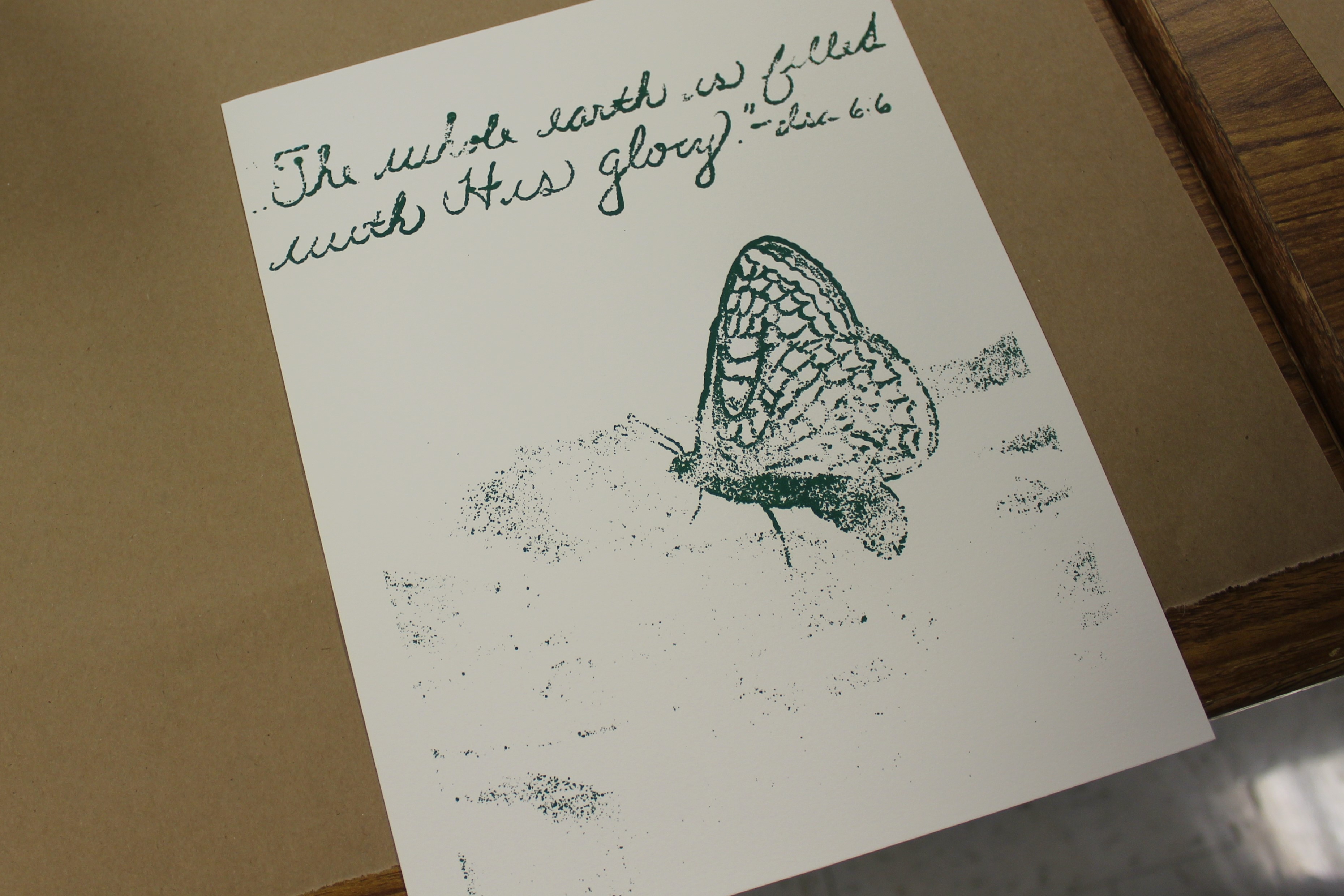
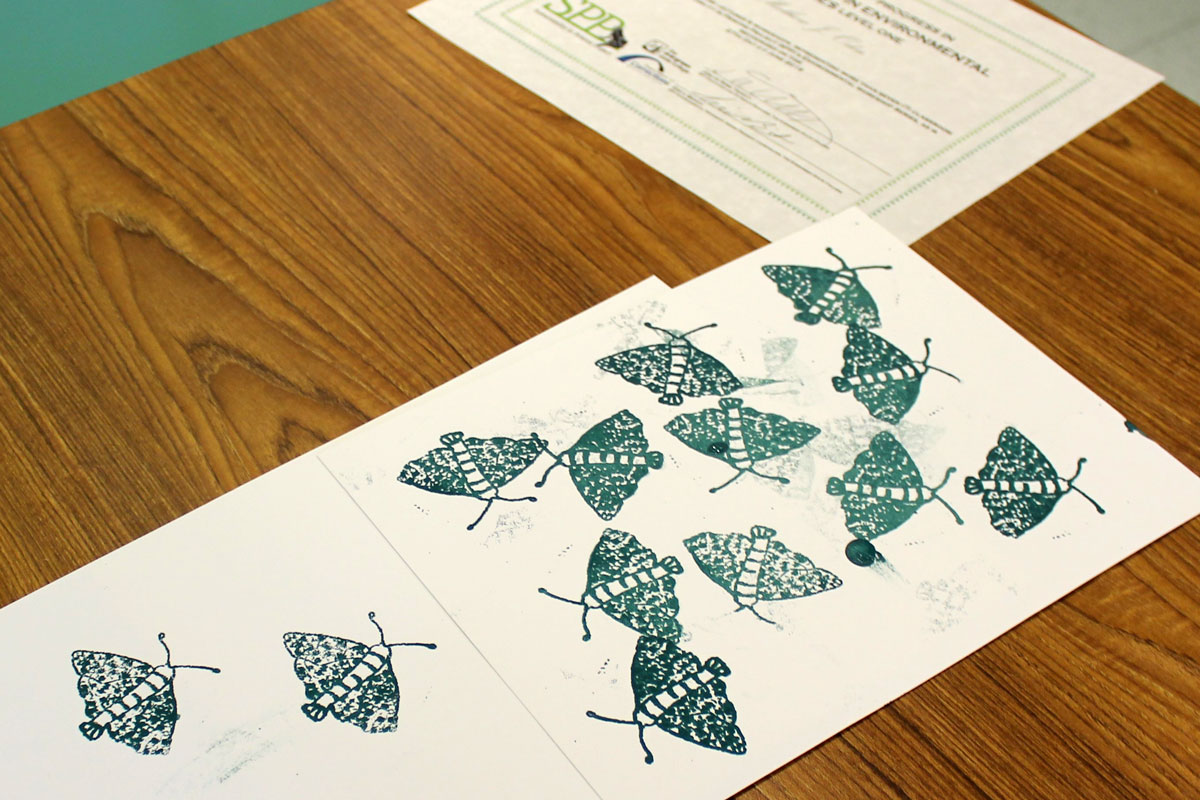
In July, incarcerated students at the Stafford Creek Corrections Center had the unique opportunity to participate in a screen-printing workshop through the SPP Workshop Series. Emily Adams of the Evergreen State College graciously offered two separate workshops so that a greater number of students could participate. Emily gave an introductory lecture on the history and process of screen-printing and then the students had about an hour to create their own prints.
Emily Adams describes the history of screen-printing in a classroom at Stafford Creek Corrections Center.
For inspiration, students had a variety of high quality
images taken from SPP’s various programs to choose from as the subject of their
screen prints. In some cases, the students practiced the skill of grid drawing
while others relied on quick tracings due to limited time.
Once they had a drawing in hand, Emily put the drawing through a Thermo Fax Machine to create a “screen,” which each student ran ink through to create the final product. The image below illustrates this process, as one student uses a squeegee to push yellow-orange ink through his screen. For the first workshop, students were pressed for time, but almost everyone was able to complete a print before the session ended.
Emily and I worked through a few logistical challenges to make the second workshop an even greater success. Most of the students in the class were able to leave the workshop with two or more different prints. We hope you enjoy some of the great prints the students created, posted below.
Workshop student Colton Green happily shows off his first screen prints!
Text and photos by Erica Benoit, SPP Environmental Workshop Series Coordinator
Note: please be aware that at least one individual featured in this story and in these images has victims who are concerned about re-victimization; any sharing or promoting of images should keep that risk in mind.
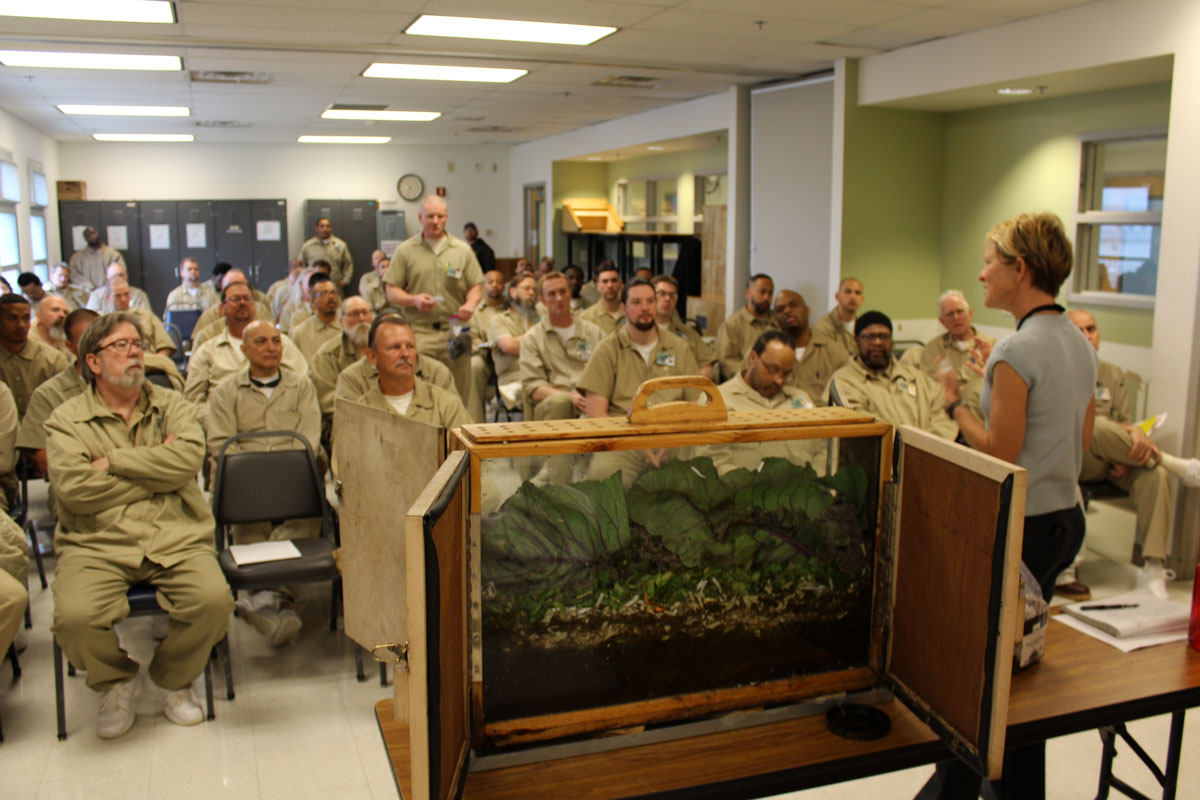
The composting program started by two incarcerated men at the Monroe Correctional Complex (MCC) has fascinated many visitors and sparked international interest. Workshop students at the Stafford Creek Corrections Center (SCCC) were no less eager to hear about this program directly from one of the founders: Rory Brown. Rory is currently incarcerated at SCCC, where he is a regular at the workshop series. In May, Rory got his first chance to stand up in front of the men he usually sits alongside. His compost program origin story was one of determination and resourcefulness.
Rory recounted how he and his counterpart, Nick Hacheney, identified food waste as an issue at MCC. With staff support and no funding, they began to scrounge up discarded materials to create worm bins. After some trial and error, they were successful; from almost nothing, they created a system that limited the facility’s food waste. The program has continued to grow over the last 9 years and is now able to process 20,000 lbs. of food waste every month.
Along with his personal anecdotes, Rory brought an excellent demonstration that showed how worms break down organic materials and shredded paper to create high-quality fertilizer that can be used in gardens. He also passed around worm castings and the finished compost product for all students to examine.
The session was co-presented by Joslyn Rose Trivett. She provided an overview of SPP’s three spheres of sustainability as well as updates on MCC’s composting program since Rory left the facility in 2014. The current compost technicians at MCC also made an appearance through a video filmed at the facility back in January. In it, they talked through the process of composting with worms, as well as their most recent endeavors with other kinds of bugs that process food waste: Bokashi and black soldier flies.
The workshop concluded with an inspiring TEDx Talk by Nick Hacheney. One workshop student enthusiastically told us that the video should be required viewing at all prisons; it demonstrates that incarcerated individuals have the power to create sustainability.
Text and photos by Erica Benoit, SPP Environmental Workshop
Series Coordinator
Professor Winterbottom first came to WCCW early in 2016, along with Dr. Barb Toews of UW-Tacoma. Both academics saw potential for building restorative landscapes at the prison, for the benefit of both incarcerated individuals and prison staff. They also found willing partners among WCCW’s leadership, particularly Associate Superintendent Felice Davis, Facilities Manager Rod Coberly, and Superintendent Jo Wofford. Even so, it took three years of persistence before Professor Winterbottom had the go-ahead to make the prison the topic of his Therapeutic Master Plan Studio class.
Last month, he and his students presented their recommendations to WCCW’s leadership, which were met with further support and enthusiasm. The next step was to get feedback from the incarcerated individuals, the folks who might be most affected by the potential project. Luckily, there was an opening in the workshop series calendar, creating the perfect opportunity to bring everyone together!
The student groups, with architecture models and posters in hand, presented projects focused on designing a nurturing and healing environment as an exercise of rethinking the landscape of incarceration.
They proposed creating places that stimulate the senses, and that offer both respite and engagement through the garden. Each proposal offered different approaches and methods, but all were intended to create a more humane place for both residents and staff.
Workshop students were especially respectful of the time and effort the UW students put into their projects, and their comments and questions reflected that appreciation.
Overall, workshop students were engaged and excited to hear about the potential to transform their built living environment.
Part Three: Session at the Women’s Prison
If you haven’t already read Part One, you can do so here, and Part Two is here.
Photos and text by Joslyn Rose Trivett, SPP Education and Outreach Manager
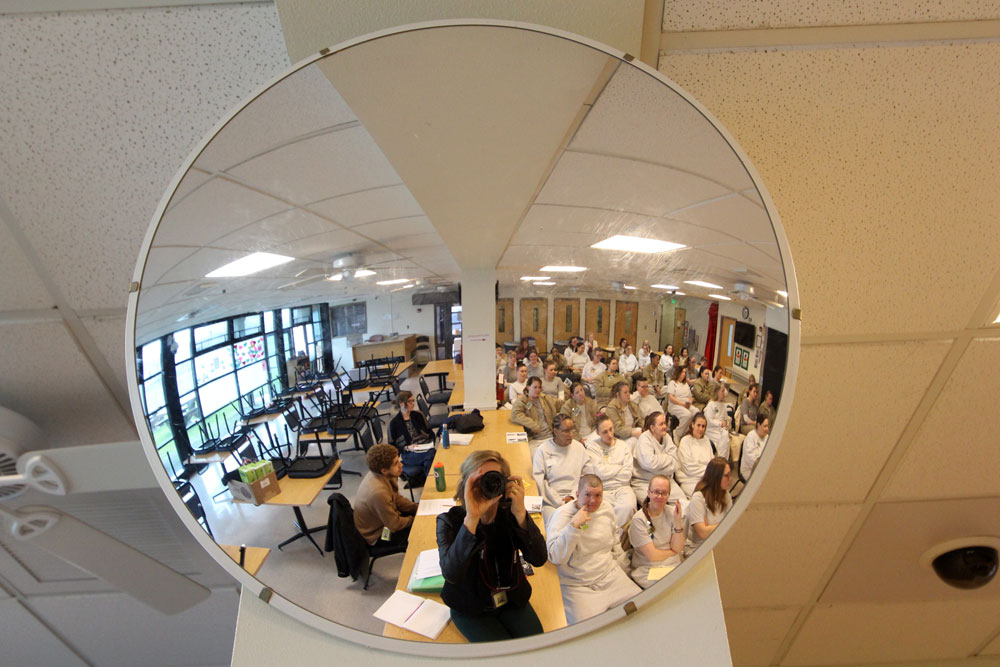
The WCCW visit room and sometimes-classroom is captured in the mirror at the front.
In January, we presented lecture survey results to students at the men’s prison, and gathered their feedback and ideas (that story here). We needed to repeat the process at Washington Corrections Center for Women (WCCW), but had to wait until there was an opening in the lecture series schedule. That time came in March.
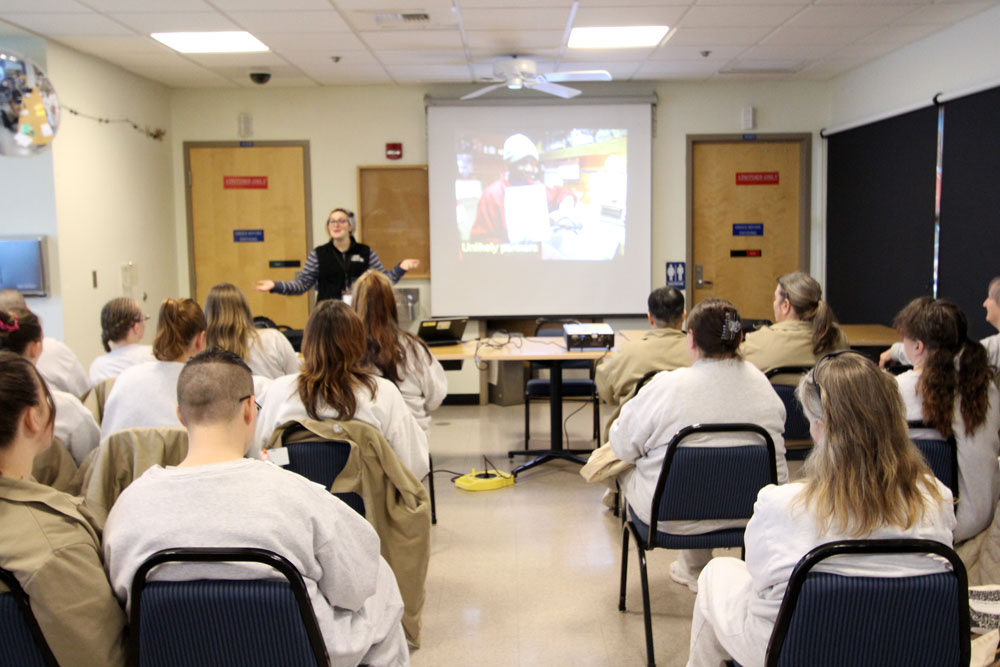
As a part of the presentation, Liliana also gave an overview of SPP programs statewide and at WCCW.
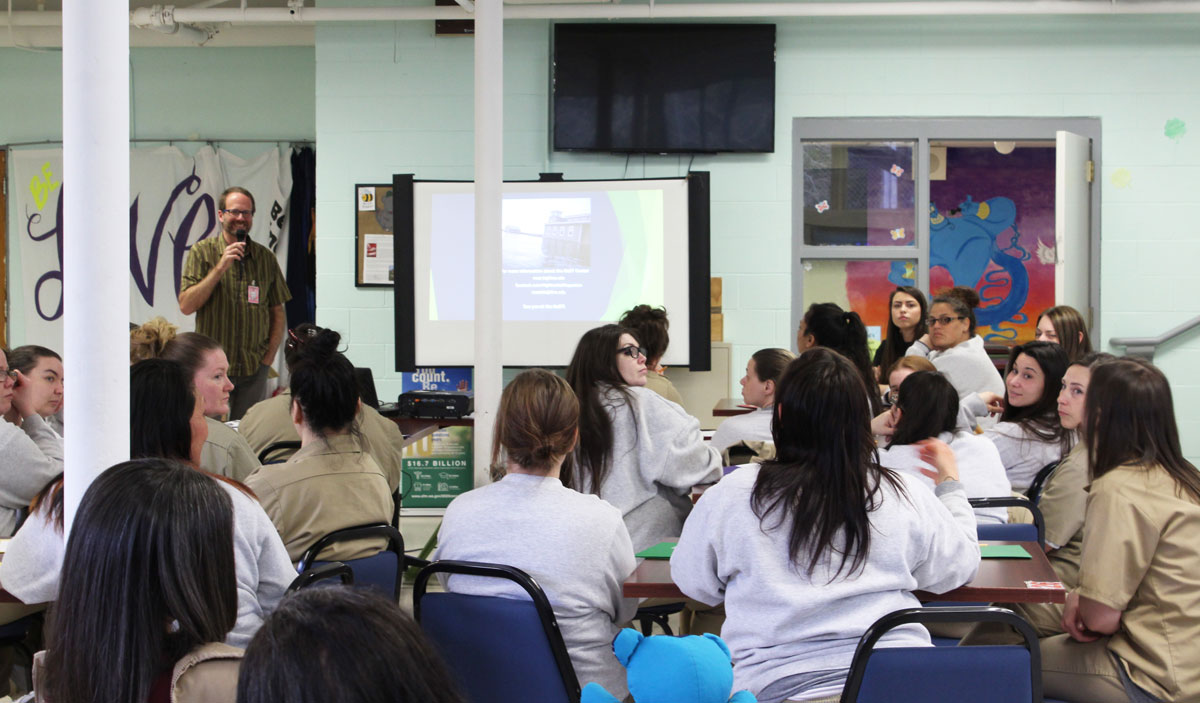
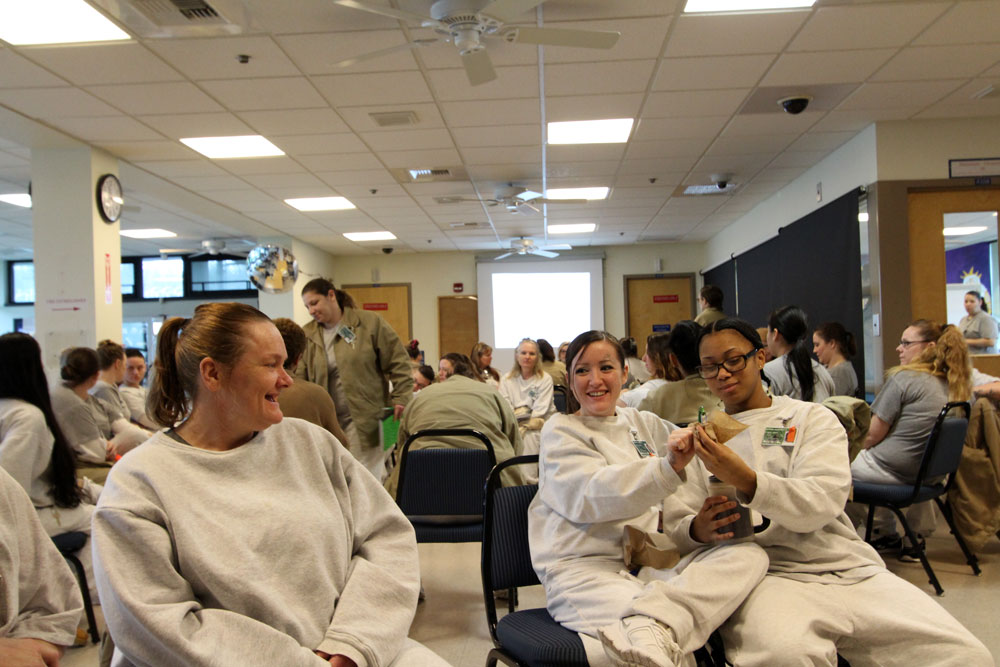
The program classroom at WCCW can have a very different feel than the one at Stafford Creek Corrections Center. Lectures are held in the visit room. The layout is not ideal, and the buzz of vending machines can be a distraction. That day, we learned from the students that program demand is met just fine by the seats and sessions available—they aren’t clamoring for more, like we hear from the male students. While Stafford Creek has nearly 2,000 residents, WCCW has less than 800, and WCCW residents can choose from a relative abundance of programming. These factors likely contribute to a somewhat more casual classroom atmosphere than at the men’s prison.
Again, Liliana Caughman presented her report from the lecture series surveys, and again the students nodded with agreement at the results. However, this group was more quick to talk about a negative result: the small number of students (5%) who respond negatively to the lectures. A student self-identified as one of these, and I was glad to hear more from her when we broke into small groups: her critique was more acute than others’, but the particulars were similar to widely-expressed comments.
More engaging!
In my small group, we passed a talking piece to make sure everyone had chances to talk, and I think it made for a high quality discussion. A few students shielded themselves from potential germs by only handling the talking piece with the help of a napkin.
Liliana, Elijah Moloney, and I each sat with a third of the group to further discuss the program and program surveys. From nearly everyone in my group, I heard that they want more interactive and varied sessions. Several students said they struggle to sit still and pay attention through a 90 minute presentation. I heard that a short presentation is fine, and especially if it includes a way to take notes (we would need to provide the paper and pencils), humor, specimens, live animals, or video. They asked us to make time for writing, worksheets, quizzes on the content, games, and individual or small group exercises. Overall, they want content that’s more “sticky.” All this lead to the most potent suggestion: they aren’t very interested in lectures, so why not call the program something else?
Good point!I recallSarah Weber’s research 2012 study that “… the lecture-style presentations appeared more effective for for male students, whereas workshop-style presentations appeared more effective for female students in improving inmate knowledge and attitudes on environmental topics.” More recent results from the men’s prison, including what we heard during the January session, point to a wide-spread preference for interactive, more engaging sessions. Lectures may be more effective at conveying information, at least for some groups, but workshops have a wide-spread, strongly positive effect on environmental attitudes.
Topics & Surveys
The students asked for sessions on sociology, psychology, communications, physiology, mental plasticity, and evolution. These are some of my favorite topics too.
Like the male students, they asked for more knowledge questions. A few suggested more variety in the questions about attitude, so that respondents are less likely to answer automatically.
What next?
I find it super satisfying to have extensive qualitative and quantitative results on the program; it makes it easy to decide what next! Here is what we will do:
Rename the program. Science and Sustainability Lecture Series has served us well for years, but it’s time for an upgrade. Program partners have agreed on Environmental Engagement Workshop Series.
Update guidelines for guest presenters, with pointers on how to create inspiring, challenging, “sticky,” content.
Recruit guests with expertise on social, political, physiological, and evolutionary aspects of the environmental field.
Increase the number of knowledge questions on the surveys.
Use a larger set of attitude questions, varying which are included each time; some questions will ask about identity and plans for action.
We have already started work on each of these actions. Liliana has started using the new name with guest presenters, and was pleased to see that the word “workshop” had the desired effect on their planning and facilitation.
I still recognize that seven years’ data from the Science and Sustainability Lecture Series showed us that the program has been enormously successful and well received. Now we are ready to make it even better!

















Once a year, SPP reports on all things sustainable happening in Washington State Prisons.