
 Composting with Bugs
Composting with Bugs
In 2010, a group of incarcerated technicians at the Washington State Reformatory Unit (WSRU) at Monroe Correctional Complex developed a composting program unlike any other. The team used vermiculture, bokashi, black soldier flies, and small scale composting to reduce food waste in prisons. This team went on to co-create SPP’s Foundations in Composting Program and document their best practices so their work could be replicated.
In 2019, past and present compost technicians pose for a photo following a graduation ceremony. Photo by Erica Benoit.

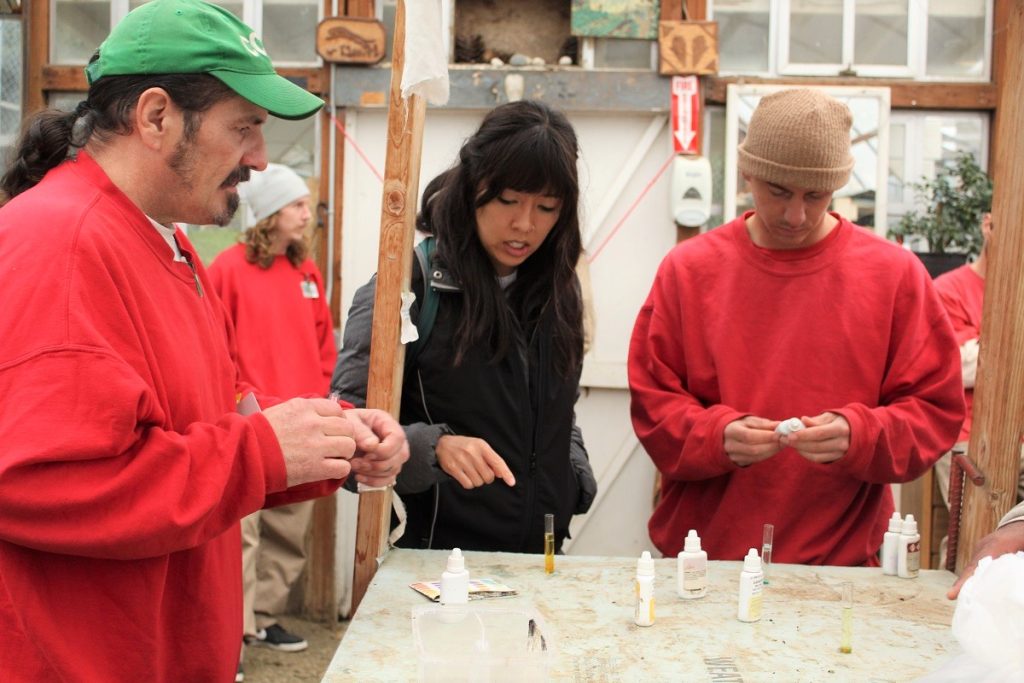
Lead technicians Juan Hernandez and Nick Hacheney talk about the program with program partners and a visiting scientist. Photo by Ricky Osborne.

Sergeant La Munyon and compost technicians work at the Zen garden -- the table where they extract red wigglers from finished worm castings. Photo by Kelli Bush.

A composting technician in the world-class program at Monroe Correctional Complex tends to the black soldier flies. Photo by Ricky Osborne.

WCC’s composting program continues to support education and training. Photos by SPP staff.

The program currently processes around 30,000 lbs of food waste every month. To transform waste into valuable resources, technicians work with three kinds of “bugs”:
- Worms (also known as red wigglers and the “vermi” in vermicomposting): Worms consume discarded grains, vegetables, and fruits. Their droppings are called castings, and worm castings are highly prized as fertilizer and soil amendment.
- Bokashi: Specialist bacteria can ferment/pre-process citrus, dairy, and meats that the worms cannot.
- Black soldier flies: Larvae of a stingless wasp (looks like a fly) can consume all kinds of food waste; they turn it into more larvae that are prized as high-quality animal feed
These approaches to composting represent relatively new technologies. Building on earlier studies, the WSRU program developed, tested, and improved methods that have been used at WCC. Chickens, even though they aren’t a bug, are the latest addition to the composting family. They can consume leftover food scraps and black soldier flies, and their droppings are a great fertilizer.
DOC & SPP’s History with Vermiculture
From the beginning, members of WSRU’s staff supported and championed the program. The program provided starter kits for other residential facilities, including the sizable worm farm in Washington State Penitentiary‘s Sustainable Operations Lab (SPL). The program worked with Seattle’s Tilth Alliance and SPP partners at Evergreen to create formal education and certification for technicians which graduated two classes. In 2018 and 2019, graduate students from the University of Washington (UW) visited the program to conduct research on soil amendments’ effects on vegetable growing. Compost technicians advised on and supported those studies. In addition, University Beyond Bars (now Reclaim) staff offered vital program support and connection to other educational efforts at the prison.
Scientists, corrections specialists, professors, students, and entrepreneurs visited and toured the facility. Technicians created a virtual tour for the International Conference on Sustainability in 2019.
Centralia College staff receive a tour in WCC’s SPL area. Photo by Emily Passarelli

Photo from 2015: 2nd generation worm bins (made from reclaimed mattress parts) and 2nd generation fly enclosure.

In 2010, friends Nick Hacheney and Rory Brown took on the challenge of composting food waste with worms. Starting with a literal handful of worms and the gumption to figure it out, they built the first bins from whatever materials they could find: laundry baskets and buckets. They were lucky to have strong support from staff members Donna Simpson and Officer Art King. These types of programs couldn’t exist without staff support.
Nick and Rory learned how to grow the number of worms in breeding bins, a process called vermiculture. They also learned how and began to refine composting with worms, known as vermicomposting. Fairly quickly, they realized they could process food waste year-round, with almost no odor. They were sold!
2014 was a year of big changes. Rory moved to another prison, Officer Jeffry Swan took over supervision, and Evergreen staff began to play a bigger role. Nick presented at Turning Keys TEDx. At the same time, technicians built new composting bins and began trials with Bokashi.
In 2015, they established the partnership with Tilth Alliance, and together with SPP-Evergreen developed a formal education curriculum. The program ended during the pandemic and WSRU closed in 2021. However, the collaboration didn’t stop there.
In 2022, SPP co-created the Foundations in Composting curriculum with former MCC technicians, Tilth Alliance, WSU professors, and other other outside partners. The course was launched in 2023 and was evaluated for college credit. Since the program was launched, over 10 cohorts at 5 facilities have completed the course. The team also went on to document protocols for food waste collection, vermiculture, and bokashi. These manuals are available for free here. SPP also offers additional composting workshops as requested.
Rick points to an adult black soldier fly enclosure. Photo by Erica Benoit.

 Read More





Once a year, SPP reports on all things sustainable happening in Washington State Prisons.